Application
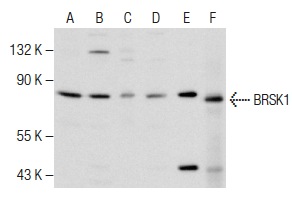
Western blot analysis of BRSK1 expression in Hep G2 (A), Jurkat (B), K-562 (C) and Raji (D) whole cell lysates and human liver (E) and mouse liver (F) tissue extracts.| Product Name | BRSK1 Antibody (N-22) |
|---|---|
| Antibody Type | Primary Antibodies |
| Antigen Alias | recommended for detection of BRSK1 of mouse and human origin by WB, IP and ELISA |
| Modification Notes | The phosphorylation and dephosphorylation of proteins on serine and threonine residues is an essential means of regulating a broad range of cellular functions in eukaryotes, including cell division, homeostasis and apoptosis. A group of proteins that are intimately involved in this process are the serine/threonine (Ser/Thr) protein kinases. BRSK1 (BR serine/threonine-protein kinase 1), also known as SAD1, is a 794 amino acid protein that localizes to both the nucleus and the cytoplasm and contains one UBA domain and one protein kinase domain. Expressed in a variety of tissues with highest expression in testis and brain, BRSK1 uses magensium as a cofactor to catalyze the ATP-dependent phosphorylation of target proteins, including Wee 1 and Cdc25B. Via its kinase activity toward proteins that are involved in microtubule assembly, BRSK1 plays an essential role in neuronal polarization and may be involved in regulating cell cycle arrest in response to DNA damage, Two isoforms of BRSK1 exist due to alternative splicing events. |
| Clonality | Polyclonal |
|---|---|
| Isotype | IgG |
| Host Species | Rabbit |
| Tested Applications | WBIPELISA |
| WB:1:500~1:2000 IP:1:100~1:500 Notes:Optimal dilutions/concentrations should be determined by the researcher. |
|
| Species Reactivity | HumanMouseRat |
| Concentration | 1mg/ml |
| Purification | Affinity purified |
| Alternative Names | recommended for detection of BRSK1 of mouse and human origin by WB IP and ELISA |
|---|---|
| Tissue Specificity | recommended for detection of BRSK1 of mouse and human origin by WB, IP and ELISA |
| Entrez Gene | 84446 |
|---|
Application
Western blot analysis of BRSK1 expression in Hep G2 (A), Jurkat (B), K-562 (C) and Raji (D) whole cell lysates and human liver (E) and mouse liver (F) tissue extracts.| Application Notes | WB:1:500~1:2000 IP:1:100~1:500 Notes:Optimal dilutions/concentrations should be determined by the researcher. |
|---|
| Form | Liquid |
|---|---|
| Storage Instructions | For short-term storage, store at 4° C. For long-term storage, aliquot and store at -20ºC or below. Avoid multiple freeze-thaw cycles. |
| Storage Buffer | phosphate buffered saline , pH 7.4, 150mM NaCl, 0.02% sodium azide and 50% glycerol. |


