Application
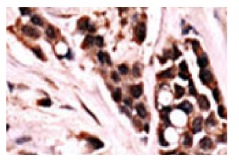
Immunoperoxidase staining of formalin fixed, paraffin-embedded human cancer tissue showing cytoplasmic staining.| Product Name | p-Separase Antibody (Ser 1073) |
|---|---|
| Antibody Type | Primary Antibodies |
| Antigen Alias | recommended for detection of Ser 1073 phosphorylated Separase of human origin by WB, IP, IF, IHC(P) and ELISA |
| Modification | Phosphoralated |
| Modification Notes | Separase is a cysteine protease that triggers anaphase in all eukaryotes by participating in separation of sister chromatids during mitosis. Once activated, Separase hydrolyzes the SCC1 subunit of cohesin, the chromosomal protein complex responsible for sister chromatid cohesion. Separase and cohesin are highly conserved from yeasts to humans. When the cell is not dividing, Separase is prevented from cleaving cohesin through its association with another protein, securin. When anaphase is signaled, the securin is ubiquitinated and hydrolyzed by APC/cyclosome, releasing the active Separase. Separase is transiently activated between the two meioses and may also be involved in homolog separation. Human Separase is subject to phosphorylation at 8 sites, one of which is Ser 1073. |
| Clonality | Polyclonal |
|---|---|
| Isotype | IgG |
| Host Species | Rabbit |
| Tested Applications | WBIPIFIHCELISA |
| WB:1:500~1:2000 IP:1:100~1:500 IF:1:200~1:500 IHC:1:50~1:200 Notes:Optimal dilutions/concentrations should be determined by the researcher. |
|
| Species Reactivity | HumanMouseRat |
| Concentration | 1mg/ml |
| Purification | Affinity purified |
| Alternative Names | recommended for detection of Ser 1073 phosphorylated Separase of human origin by WB IP IF IHC(P) and ELISA |
|---|---|
| Tissue Specificity | recommended for detection of Ser 1073 phosphorylated Separase of human origin by WB, IP, IF, IHC(P) and ELISA |
| Entrez Gene | 9700 |
|---|
Application
Immunoperoxidase staining of formalin fixed, paraffin-embedded human cancer tissue showing cytoplasmic staining.| Application Notes | WB:1:500~1:2000 IP:1:100~1:500 IF:1:200~1:500 IHC:1:50~1:200 Notes:Optimal dilutions/concentrations should be determined by the researcher. |
|---|
| Form | Liquid |
|---|---|
| Storage Instructions | For short-term storage, store at 4° C. For long-term storage, aliquot and store at -20ºC or below. Avoid multiple freeze-thaw cycles. |
| Storage Buffer | phosphate buffered saline , pH 7.4, 150mM NaCl, 0.02% sodium azide and 50% glycerol. |


