Application
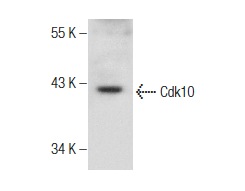
Western blot analysis of Cdk10 expression in T-47D whole cell lysate.| Product Name | Cdk10 Antibody (H-65) |
|---|---|
| Antibody Type | Primary Antibodies |
| Antigen Alias | epitope corresponding to amino acids 98-162 mapping within an internal region of Cdk10 of human origin |
| Modification Notes | Cell cycle progression is controlled, in part, by a family of cyclin dependent kinases (Cdks) that work to phosphorylate key substrates involved in each phase of cell cycle progression. Cdks are the catalytic subunits of serine/ threonine protein kinases, a large family of proteins that act as regulators of the eukaryotic cell cycle. Several Cdk family members have been identified, including Cdc2 p34, Cdk2-10, PITSLRE, PCTAIRE-1-3, KKIAMRE, KKIALRE, CDKN3 and NKIAMRE. Cdk10, also called PISSLRE, is a Cdc2-related kinase whose gene has been shown to encode two isoforms, each having a different function within the cell cycle. Although the two isoforms share nearly identical amino acid seqeunces, they differ at the C- and N- terminals. One Cdk isoform interacts with the transcription factor Ets-2, thereby modulating its transactivation activity, while the other is thought to have a role at the G2/M transition. Cdk10 mRNA has been shown to have the highest expression in lung, liver and kidney tissue, with gene upregulation implicated in cases of non-Hodgkin’s follicular lymphoma. |
| Clonality | Polyclonal |
|---|---|
| Isotype | IgG |
| Host Species | Rabbit |
| Tested Applications | WBIPIFELISA |
| recommended for detection of Cdk10 of mouse, rat and human origin by WB, IP, IF and ELISA also reactive with additional species, including equine, canine, bovine, porcine and avian: |
|
| Species Reactivity | HumanMouseRat |
| Concentration | 1mg/ml |
| Purification | Affinity purified |
| Alternative Names | epitope corresponding to amino acids 98-162 mapping within an internal region of Cdk10 of human origin |
|---|---|
| Tissue Specificity | epitope corresponding to amino acids 98-162 mapping within an internal region of Cdk10 of human origin |
| Entrez Gene | 8558 |
|---|
Application
Western blot analysis of Cdk10 expression in T-47D whole cell lysate.| Application Notes | recommended for detection of Cdk10 of mouse, rat and human origin by WB, IP, IF and ELISA also reactive with additional species, including equine, canine, bovine, porcine and avian: |
|---|
| Form | Liquid |
|---|---|
| Storage Instructions | For short-term storage, store at 4° C. For long-term storage, aliquot and store at -20ºC or below. Avoid multiple freeze-thaw cycles. |
| Storage Buffer | phosphate buffered saline , pH 7.4, 150mM NaCl, 0.02% sodium azide and 50% glycerol. |


