Application
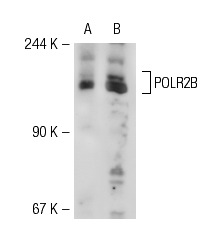
Western blot analysis of POLR2B expression in 293T whole cell lysate (A) and Ramos nuclear extract (B).| Product Name | POLR2B Antibody (H-201) |
|---|---|
| Antibody Type | Primary Antibodies |
| Antigen Alias | epitope corresponding to amino acids 184-384 mapping near the N-terminus of POLR2B of human origin |
| Modification Notes | RNA polymerase II (Pol II) is a multi-subunit complex responsible for catalyzing the transcription of DNA into RNA. POLR2B (polymerase (RNA) II (DNA directed) polypeptide B), also known as RPB2 (RNA polymerase II subunit B2), is a 1174 amino acid protein that is the second largest subunit in the Pol II complex. POLR2B, along with the other Pol II subunits, uses the four ribonucleoside triphosphates as substrates to catalyze the transcription of DNA to RNA. Localized to the nucleus, POLR2B is one of at least three subunits that form a structure which is essential in maintaining contact between the active site of Pol II and the DNA template/newly synthesized RNA. In addition to POLR2B, this complex contains the central large cleft; a clamp element that opens and closes the cleft and functions to grab the incoming DNA template. |
| Clonality | Polyclonal |
|---|---|
| Isotype | IgG |
| Host Species | Rabbit |
| Tested Applications | WBIPIFELISA |
| recommended for detection of POLR2B of mouse, rat and human origin by WB, IP, IF and ELISA also reactive with additional species, including equine, canine, bovine, porcine and avian: |
|
| Species Reactivity | HumanMouseRat |
| Concentration | 1mg/ml |
| Purification | Affinity purified |
| Alternative Names | epitope corresponding to amino acids 184-384 mapping near the N-terminus of POLR2B of human origin |
|---|---|
| Tissue Specificity | epitope corresponding to amino acids 184-384 mapping near the N-terminus of POLR2B of human origin |
| Entrez Gene | 5431 |
|---|
Application
Western blot analysis of POLR2B expression in 293T whole cell lysate (A) and Ramos nuclear extract (B).| Application Notes | recommended for detection of POLR2B of mouse, rat and human origin by WB, IP, IF and ELISA also reactive with additional species, including equine, canine, bovine, porcine and avian: |
|---|
| Form | Liquid |
|---|---|
| Storage Instructions | For short-term storage, store at 4° C. For long-term storage, aliquot and store at -20ºC or below. Avoid multiple freeze-thaw cycles. |
| Storage Buffer | phosphate buffered saline , pH 7.4, 150mM NaCl, 0.02% sodium azide and 50% glycerol. |


