Application
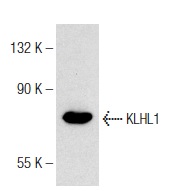
Western blot analysis of KLHL1 expression in 293T whole cell lysate.Application
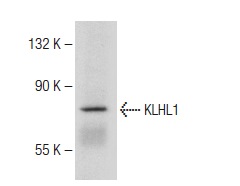
Western blot analysis of KLHL1 expression in HL-60 whole cell lysate.Application
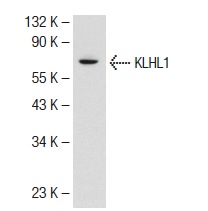
Western blot analysis of KLHL1 expression in HeLa whole cell lysate.| Product Name | KLHL1 Antibody (N-18) |
|---|---|
| Antibody Type | Primary Antibodies |
| Antigen Alias | epitope mapping near the N-terminus of KLHL1 of human origin |
| Modification Notes | KLHL1 (kelch-like protein 1) is a 748 amino acid protein that is the homolog of the Drosophila kelch protein. Localized to the cytoskeleton, KLHL1 contains six kelch repeats and one BTB (POZ) domain. The BTB (Broad-Complex, Tramtrack and Bric a brac) domain, also known as the POZ (Poxvirus and Zinc finger) domain, is an N-terminal homodimerization domain that contains multiple copies of kelch repeats and/or C2H2-type zinc fingers. KLHL1 is highly expressed in brain where it acts as an actin-organization protein, possibly playing a role in the modulation of neurite outgrowth. KLHL1 expression has been shown to be downregulated by spinocerebellar ataxia type 8 (SCA8) protein, which then leads to SCA8 neuropathogenesis, a disease that is characterized by limb and truncal ataxia, ataxic dysarthria and horizontal nystagmus. |
| Clonality | Polyclonal |
|---|---|
| Isotype | IgG |
| Host Species | Rabbit |
| Tested Applications | WBIPIFELISA |
| recommended for detection of KLHL1 of mouse, rat and human origin by WB, IP, IF and ELISA also reactive with additional species, including equine, bovine and porcine: |
|
| Species Reactivity | HumanMouseRat |
| Concentration | 1mg/ml |
| Purification | Affinity purified |
| Alternative Names | epitope mapping near the N-terminus of KLHL1 of human origin |
|---|---|
| Tissue Specificity | epitope mapping near the N-terminus of KLHL1 of human origin |
| Entrez Gene | 57626 |
|---|
Application
Western blot analysis of KLHL1 expression in 293T whole cell lysate.
Application
Western blot analysis of KLHL1 expression in HL-60 whole cell lysate.
Application
Western blot analysis of KLHL1 expression in HeLa whole cell lysate.| Application Notes | recommended for detection of KLHL1 of mouse, rat and human origin by WB, IP, IF and ELISA also reactive with additional species, including equine, bovine and porcine: |
|---|
| Form | Liquid |
|---|---|
| Storage Instructions | For short-term storage, store at 4° C. For long-term storage, aliquot and store at -20ºC or below. Avoid multiple freeze-thaw cycles. |
| Storage Buffer | phosphate buffered saline , pH 7.4, 150mM NaCl, 0.02% sodium azide and 50% glycerol. |


