Application
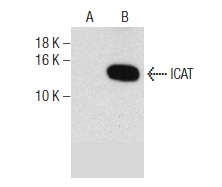
Western blot analysis of ICAT expression in non-transfected: (A) and human ICAT transfected: (B) 293T whole cell lysates.| Product Name | ICAT Antibody (FL-81) |
|---|---|
| Antibody Type | Primary Antibodies |
| Antigen Alias | epitope corresponding to amino acids 1-81 representing full length ICAT of human origin |
| Modification Notes | ICAT interacts directly with ∫-catenin and interferes with the Wnt signaling pathway. Specifically, ICAT prevents the interaction of ∫-catenin with TCF-4 and inhibits ∫-catenin--TCF-4-mediated transactivation. The negative regulatory effect of ICAT on the Wnt signaling pathway appears to inhibit tumor cell proliferation. ICAT also induces G2 arrest followed by cell death in colorectal tumor cells. The ectopic induction of ICAT inhibits the expression of ∫3 Tubulin and thus neuronal differentiation in embryonal carcinoma P19 cells. Structural characteristics of ICAT include a three-helix bundle and a C-terminal tail. The gene encoding human ICAT maps to chromosome 1p36.22. |
| Clonality | Polyclonal |
|---|---|
| Isotype | IgG |
| Host Species | Rabbit |
| Tested Applications | WBIPIFELISA |
| recommended for detection of ICAT of mouse, rat and human origin by WB, IP, IF and ELISA also reactive with additional species, including equine, bovine and avian: |
|
| Species Reactivity | HumanMouseRat |
| Concentration | 1mg/ml |
| Purification | Affinity purified |
| Alternative Names | epitope corresponding to amino acids 1-81 representing full length ICAT of human origin |
|---|---|
| Tissue Specificity | epitope corresponding to amino acids 1-81 representing full length ICAT of human origin |
Application
Western blot analysis of ICAT expression in non-transfected: (A) and human ICAT transfected: (B) 293T whole cell lysates.| Application Notes | recommended for detection of ICAT of mouse, rat and human origin by WB, IP, IF and ELISA also reactive with additional species, including equine, bovine and avian: |
|---|
| Form | Liquid |
|---|---|
| Storage Instructions | For short-term storage, store at 4° C. For long-term storage, aliquot and store at -20ºC or below. Avoid multiple freeze-thaw cycles. |
| Storage Buffer | phosphate buffered saline , pH 7.4, 150mM NaCl, 0.02% sodium azide and 50% glycerol. |


