Application
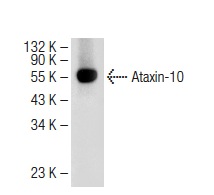
Western blot analysis of Ataxin-10 expression in mouse adrenal tissue extract.| Product Name | Ataxin-10 Antibody (H-176) |
|---|---|
| Antibody Type | Primary Antibodies |
| Antigen Alias | epitope corresponding to amino acids 15-190 mapping near the N-terminus of Ataxin-10 of human origin |
| Modification Notes | Spinocerebellar ataxia (SCA) is an autosomal dominant neurodegenerative disorder characterized by ataxia and selective neuronal cell loss. SCA is caused by the expansion of a translated CAG repeat, encoding a polyglutamine tract in SCA gene products, known as ataxins. The ataxin proteins are ubiquitously expressed in nervous tissue, but are primarily detected in cerebellum, brain stem and spinal cord in the central nervous system. Ataxin-10 is a cytoplasmic protein that belongs to the family of armadillo repeat proteins. A loss of ataxin-10 in primary neuronal cells causes increased apoptosis of cerebellar neurons. Ataxin-10 interacts with p110, an O-Linked beta-N-acetylglucosamine transferase, and may be important in the regulation of intracellular glycosylation levels and homeostasis in the brain. Spinocerebellar ataxia type 10 (SCA10) is an autosomal dominant disorder that causes cerebellar ataxia and seizures. SCA10 is caused by an expansion of an ATTCT pentanucleotide repeat in intron 9 of the ataxin-10 gene. |
| Clonality | Polyclonal |
|---|---|
| Isotype | IgG |
| Host Species | Rabbit |
| Tested Applications | WBIPIFELISA |
| recommended for detection of Ataxin-10 of mouse, rat and human origin by WB, IP, IF and ELISA also reactive with additional species, including canine, bovine and porcine: |
|
| Species Reactivity | HumanMouseRat |
| Concentration | 1mg/ml |
| Purification | Affinity purified |
| Alternative Names | epitope corresponding to amino acids 15-190 mapping near the N-terminus of Ataxin-10 of human origin |
|---|---|
| Tissue Specificity | epitope corresponding to amino acids 15-190 mapping near the N-terminus of Ataxin-10 of human origin |
| Entrez Gene | 25814 |
|---|
Application
Western blot analysis of Ataxin-10 expression in mouse adrenal tissue extract.| Application Notes | recommended for detection of Ataxin-10 of mouse, rat and human origin by WB, IP, IF and ELISA also reactive with additional species, including canine, bovine and porcine: |
|---|
| Form | Liquid |
|---|---|
| Storage Instructions | For short-term storage, store at 4° C. For long-term storage, aliquot and store at -20ºC or below. Avoid multiple freeze-thaw cycles. |
| Storage Buffer | phosphate buffered saline , pH 7.4, 150mM NaCl, 0.02% sodium azide and 50% glycerol. |


