Application
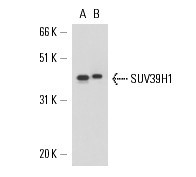
Western blot analysis of SUV39H1 expression in HeLa (A) nuclear extract and HeLa (B) whole cell lysate.| Product Name | SUV39H1 Antibody (H-55) |
|---|---|
| Antibody Type | Primary Antibodies |
| Antigen Alias | epitope corresponding to amino acids 166-220 of SUV39H1 of human origin |
| Modification Notes | Distinct modifications of histone tails, such as acetylation, phosphorylation and methylation, regulate nuclear processes by organizing the chromatin into higher order structures. Higher-order chromatin influences chromosome function and epigenetic gene regulation. Human and murine SUV39H1 are mammalian homologes of Drosophila Su(var)3-9 and of Schizosaccharomyces pombe clr4, which encode Histone H3-specific methyltransferases. SUV39H1, suppressor of variegation 3-9, selectively methylates Lysine 9 of the amino terminus of Histone H3 to generate a binding site for HP1 proteins. These HP1 proteins belong to a family of heterochromatic adaptor molecules that are implicated in both gene silencing and supra-nucleosomal chromatin structure. SUV39H1 contains both SET and chromo domains and is ubiquitously expressed. The enrichment of SUV39H1 at heterochromatic foci during interphase and centromere-specific localization during metaphase depends on the C-terminal SET domain. SUV39H1 is phosphorylated specifically at the G1/S cell cycle transition and, when forcibly expressed, suppresses cell growth. SUV39H1 acts as a long-range repressor that is capable of acting over several kilobases to silence basal promoters. |
| Clonality | Polyclonal |
|---|---|
| Isotype | IgG |
| Host Species | Rabbit |
| Tested Applications | WBIPIFELISA |
| recommended for detection of SUV39H1 of mouse, rat and human origin by WB, IP, IF and ELISA also reactive with additional species, including canine and bovine: |
|
| Species Reactivity | HumanMouseRat |
| Concentration | 1mg/ml |
| Purification | Affinity purified |
| Alternative Names | epitope corresponding to amino acids 166-220 of SUV39H1 of human origin |
|---|---|
| Tissue Specificity | epitope corresponding to amino acids 166-220 of SUV39H1 of human origin |
| Entrez Gene | 6839 |
|---|
Application
Western blot analysis of SUV39H1 expression in HeLa (A) nuclear extract and HeLa (B) whole cell lysate.| Application Notes | recommended for detection of SUV39H1 of mouse, rat and human origin by WB, IP, IF and ELISA also reactive with additional species, including canine and bovine: |
|---|
| Form | Liquid |
|---|---|
| Storage Instructions | For short-term storage, store at 4° C. For long-term storage, aliquot and store at -20ºC or below. Avoid multiple freeze-thaw cycles. |
| Storage Buffer | phosphate buffered saline , pH 7.4, 150mM NaCl, 0.02% sodium azide and 50% glycerol. |


