Application
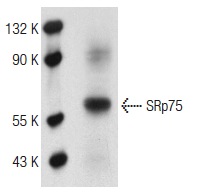
Western blot analysis of SRp75 expression in L8 whole cell lysate.| Product Name | SRp75 Antibody (M-41) |
|---|---|
| Antibody Type | Primary Antibodies |
| Antigen Alias | epitope corresponding to amino acids 259-299 mapping within an internal region of SRp75 of mouse origin |
| Modification Notes | SRp75, also designated splicing factor, arginine/serine-rich 4 (SFRS4), is a splicing factor that can undergo phosphorylation. SRp75 is similar to other SR proteins, containing an N-terminal RNA recognition motif (RRM), a glycine-rich region, an internal region homologous to the RRM and a long 315 amino acid C-terminal serine/arginine-rich domain. SRp75, Pnn, SRm300 and SRrp130 components of spliceosome machinery can co-localize and co-immunoprecipitate with one another and exhibit speckled nuclear distribution that aligns with components of pre-mRNA splicing machinery. Alternative mRNA splicing plays an important role in development and differentiation; many transcripts are spliced differently in distinct cell types and tissues. Both constitutive and alternative splicing occurs on spliceosomes, which are complex particles composed of small nuclear ribonucleoproteins (snRNPs) and non-snRNP proteins. The SR family of non-snRNP splicing factors contain an RNA recognition motif and a serine- and arginine-rich (SR) domain. SR proteins are required at early stages of spliceosome assembly, have distinct but overlapping specificities for different pre-mRNAs and can alter splice site choice. |
| Clonality | Polyclonal |
|---|---|
| Isotype | IgG |
| Host Species | Rabbit |
| Tested Applications | WBIPIFELISA |
| recommended for detection of SRp75 of mouse and rat origin by WB, IP, IF and ELISA: |
|
| Species Reactivity | HumanMouseRat |
| Concentration | 1mg/ml |
| Purification | Affinity purified |
| Alternative Names | epitope corresponding to amino acids 259-299 mapping within an internal region of SRp75 of mouse origin |
|---|---|
| Tissue Specificity | epitope corresponding to amino acids 259-299 mapping within an internal region of SRp75 of mouse origin |
Application
Western blot analysis of SRp75 expression in L8 whole cell lysate.| Application Notes | recommended for detection of SRp75 of mouse and rat origin by WB, IP, IF and ELISA: |
|---|
| Form | Liquid |
|---|---|
| Storage Instructions | For short-term storage, store at 4° C. For long-term storage, aliquot and store at -20ºC or below. Avoid multiple freeze-thaw cycles. |
| Storage Buffer | phosphate buffered saline , pH 7.4, 150mM NaCl, 0.02% sodium azide and 50% glycerol. |


