Application
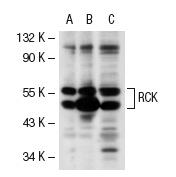
Western blot analysis of RCK expression in non-transfected 293T: (A), human RCK transfected 293T: (B) and K-562 (C) whole cell lysates.| Product Name | RCK Antibody (H-110) |
|---|---|
| Antibody Type | Primary Antibodies |
| Antigen Alias | epitope corresponding to amino acids 61-170 mapping near the N-terminus of RCK of human origin |
| Modification Notes | RCK, also known as DDX6 and P54, is a member of the DEAD-box RNA helicase family of proteins, all of which share common protein motifs. Found in most tissues, RCK is an unwindase that exhibits ATP-dependent RNA un-winding activity, as well as the ability to decay RNA in the 5'-3' direction. In non-malignant cells, RCK is associated with all processes of normal RNA metabolism including splicing, export and translation initiation. Mutations in the gene encoding RCK can cause the protein to be overexpressed, changing its function to that of an oncogene that positively regulates the expression of genes involved in cell growth and proliferation. It is believed that, through its unwindase activity, the main function of RCK is to downregulate mRNA expression and maintain normal transcriptional levels within the cell. |
| Clonality | Polyclonal |
|---|---|
| Isotype | IgG |
| Host Species | Rabbit |
| Tested Applications | WBIPIFELISA |
| recommended for detection of RCK of mouse, rat and human origin by WB, IP, IF and ELISA also reactive with additional species, including equine, canine, bovine, porcine and avian: |
|
| Species Reactivity | HumanMouseRat |
| Concentration | 1mg/ml |
| Purification | Affinity purified |
| Alternative Names | epitope corresponding to amino acids 61-170 mapping near the N-terminus of RCK of human origin |
|---|---|
| Tissue Specificity | epitope corresponding to amino acids 61-170 mapping near the N-terminus of RCK of human origin |
| Entrez Gene | 1656 |
|---|
Application
Western blot analysis of RCK expression in non-transfected 293T: (A), human RCK transfected 293T: (B) and K-562 (C) whole cell lysates.| Application Notes | recommended for detection of RCK of mouse, rat and human origin by WB, IP, IF and ELISA also reactive with additional species, including equine, canine, bovine, porcine and avian: |
|---|
| Form | Liquid |
|---|---|
| Storage Instructions | For short-term storage, store at 4° C. For long-term storage, aliquot and store at -20ºC or below. Avoid multiple freeze-thaw cycles. |
| Storage Buffer | phosphate buffered saline , pH 7.4, 150mM NaCl, 0.02% sodium azide and 50% glycerol. |


