Application
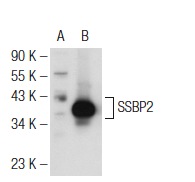
Western blot analysis of SSBP2 expression in non-transfected: (A) and mouse SSBP2 transfected: (B) 293T whole cell lysates.Application
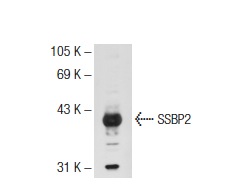
Western blot analysis of SSBP2 expression in Raji whole cell lysate.| Product Name | SSBP2 Antibody (H-45) |
|---|---|
| Antibody Type | Primary Antibodies |
| Antigen Alias | epitope corresponding to amino acids 311-355 mapping near the C-terminus of SSBP2 of human origin |
| Modification Notes | The single-stranded-DNA-binding proteins (SSBs) are essential for DNA function in prokaryotic and eukaryotic cells, as well as in mitochondria, bacteria and viruses. SSBP2 (single-stranded DNA binding protein 2), also known as SSDP2, is a 361 amino acid protein that localizes to the nucleus and contains one LisH domain. Expressed ubiquitously, SSBP2 is thought to induce growth arrest in cancer cells and may, therefore, function as a potent tumor suppressor. The gene encoding SSBP2 maps to human chromosome 5, which contains 181 million base pairs and comprises nearly 6% of the human genome. Defects in chromosome 5-associated genes are related to the pathogenesis of Cockayne syndrome, familial adenomatous polyposis and Treacher Collins syndrome. |
| Clonality | Polyclonal |
|---|---|
| Isotype | IgG |
| Host Species | Rabbit |
| Tested Applications | WBIPIFELISA |
| recommended for detection of SSBP2 of mouse, rat and human origin by WB, IP, IF and ELISA may cross-react with SSBP3 and SSBP4 also reactive with additional species, including equine, canine, bovine, porcine and avian: |
|
| Species Reactivity | HumanMouseRat |
| Concentration | 1mg/ml |
| Purification | Affinity purified |
| Alternative Names | epitope corresponding to amino acids 311-355 mapping near the C-terminus of SSBP2 of human origin |
|---|---|
| Tissue Specificity | epitope corresponding to amino acids 311-355 mapping near the C-terminus of SSBP2 of human origin |
| Entrez Gene | 23635 |
|---|
Application
Western blot analysis of SSBP2 expression in non-transfected: (A) and mouse SSBP2 transfected: (B) 293T whole cell lysates.
Application
Western blot analysis of SSBP2 expression in Raji whole cell lysate.| Application Notes | recommended for detection of SSBP2 of mouse, rat and human origin by WB, IP, IF and ELISA may cross-react with SSBP3 and SSBP4 also reactive with additional species, including equine, canine, bovine, porcine and avian: |
|---|
| Form | Liquid |
|---|---|
| Storage Instructions | For short-term storage, store at 4° C. For long-term storage, aliquot and store at -20ºC or below. Avoid multiple freeze-thaw cycles. |
| Storage Buffer | phosphate buffered saline , pH 7.4, 150mM NaCl, 0.02% sodium azide and 50% glycerol. |


