Application
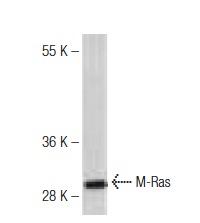
Western blot analysis of M-Ras expression in Jurkat whole cell lysate.| Product Name | M-Ras Antibody (G-21) |
|---|---|
| Antibody Type | Primary Antibodies |
| Antigen Alias | recommended for detection of M-Ras of human origin by WB, IP and ELISA |
| Modification Notes | The mammalian c-H-, c-K- and N-Ras proto-oncogenes encode proteins that are ubiquitously expressed in vertebrate cells. c-H- and c-K-Ras are cellular homologs of the v-H- and v-K-Ras sequences originally isolated from the Harvey and Kirsten strains of rat sarcoma virus. p21Ras-encoded proteins bind GDP and GTP with high affinity and possess a low level intrinsic GTPase activity that can be stimulated over 100-fold by interaction with cytosolic GTPase activating protein (GAP), a potential effector for Ras p21 function. Point mutations at amino acids 12, 13, 59 and 61 within domains responsible for GTP binding and hydrolysis activate Ras proteins to their oncogenic form and block the ability of their GTPase activities to be stimulated by GAP. M-Ras has been identified as a GTPase that shares structural similarities to the Ras family proteins. M-Ras is thought to play a role in reorganization of the actin cytoskeleton. |
| Clonality | Polyclonal |
|---|---|
| Isotype | IgG |
| Host Species | Rabbit |
| Tested Applications | WBIPELISA |
| WB:1:500~1:2000 IP:1:100~1:500 Notes:Optimal dilutions/concentrations should be determined by the researcher. |
|
| Species Reactivity | HumanMouseRat |
| Concentration | 1mg/ml |
| Purification | Affinity purified |
| Alternative Names | recommended for detection of M-Ras of human origin by WB IP and ELISA |
|---|---|
| Tissue Specificity | recommended for detection of M-Ras of human origin by WB, IP and ELISA |
| Entrez Gene | 22808 |
|---|
Application
Western blot analysis of M-Ras expression in Jurkat whole cell lysate.| Application Notes | WB:1:500~1:2000 IP:1:100~1:500 Notes:Optimal dilutions/concentrations should be determined by the researcher. |
|---|
| Form | Liquid |
|---|---|
| Storage Instructions | For short-term storage, store at 4° C. For long-term storage, aliquot and store at -20ºC or below. Avoid multiple freeze-thaw cycles. |
| Storage Buffer | phosphate buffered saline , pH 7.4, 150mM NaCl, 0.02% sodium azide and 50% glycerol. |


