Application
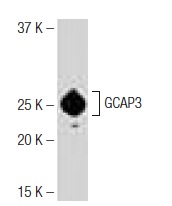
Western blot analysis of GCAP3 expression in Y79 whole cell lysate.| Product Name | GCAP3 Antibody (W-23) |
|---|---|
| Antibody Type | Primary Antibodies |
| Antigen Alias | recommended for detection of GCAP3 of human origin by WB, IP and ELISA |
| Modification Notes | The intracellular stimulation of guanylate cyclase (GC) by calcium, a key event in the recovery of the dark state of rod photoreceptors after exposure to light, is mediated by guanylate cyclase-activating proteins (GCAP). GCAPs are calcium-binding proteins belonging to the calmodulin superfamily and are specifically expressed in retina. GCAP3 (Guanylyl cyclase-activating protein 3), also known as GUCA1C (Guanylate cyclase activator 1C), is a 209 amino acid EF-hand calcium binding protein that is activated by the decrease in calcium from the absorption of light by rhodopsin. Activation of GCAP3 leads to stimulation of guanylate cyclase 1 and 2 (GC1 and GC2), which increases cGMP concentration. Calcium sensitive regulation of GC is essential in recovery of the rod receptor dark state following light exposure. There are two isoforms of GCAP3 that are produced as a result of alternative splicing events. |
| Clonality | Polyclonal |
|---|---|
| Isotype | IgG |
| Host Species | Rabbit |
| Tested Applications | WBIPELISA |
| WB:1:500~1:2000 IP:1:100~1:500 Notes:Optimal dilutions/concentrations should be determined by the researcher. |
|
| Species Reactivity | HumanMouseRat |
| Concentration | 1mg/ml |
| Purification | Affinity purified |
| Alternative Names | recommended for detection of GCAP3 of human origin by WB IP and ELISA |
|---|---|
| Tissue Specificity | recommended for detection of GCAP3 of human origin by WB, IP and ELISA |
| Entrez Gene | 9626 |
|---|
Application
Western blot analysis of GCAP3 expression in Y79 whole cell lysate.| Application Notes | WB:1:500~1:2000 IP:1:100~1:500 Notes:Optimal dilutions/concentrations should be determined by the researcher. |
|---|
| Form | Liquid |
|---|---|
| Storage Instructions | For short-term storage, store at 4° C. For long-term storage, aliquot and store at -20ºC or below. Avoid multiple freeze-thaw cycles. |
| Storage Buffer | phosphate buffered saline , pH 7.4, 150mM NaCl, 0.02% sodium azide and 50% glycerol. |


