Application
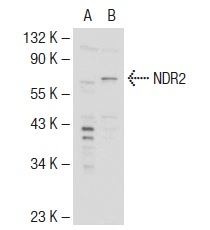
Western blot analysis of NDR2 expression in non-transfected: (A) and human NDR2 transfected: (B) 293 whole cell lysates.Application
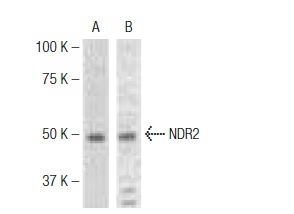
Western blot analysis of NDR2 expression in Jurkat (A) and T-47D (B) whole cell lysates.| Product Name | NDR2 Antibody (K-22) |
|---|---|
| Antibody Type | Primary Antibodies |
| Antigen Alias | recommended for detection of NDR2 of human origin by WB, IP and ELISA |
| Modification Notes | The nuclear Dbf2-related kinases (NDR-1 and NDR-2) participate in the regulation of cell division and morphology, and may be implicated in tumor progression. NDR-1 and NDR-2 share 86% amino acid identity, but differ in their expression pattern. NDR-1 localizes to the nucleus, while NDR-2 exhibits punctate cytoplasmic distribution. Also, NDR-1 expression appears highest in spleen, lung and thymus, whereas NDR-2 shows highest expression in the gastrointestinal tract. However, both NDR-1 and NDR-2 are regulated by phosphorylation and by the Ca2+-binding protein S100B. NDR-1 and NDR-2 may also play a role in the HIV-1 life cycle. Both proteins are cleaved by the HIV-1 protease (PR), which inhibits their enzymatic activity and alters the subcellular localization of NDR-2. The genes encoding human NDR-1 and NDR-2 map to chromosomes 6p21 and 12p11.23, respectively. |
| Clonality | Polyclonal |
|---|---|
| Isotype | IgG |
| Host Species | Rabbit |
| Tested Applications | WBIPELISA |
| WB:1:500~1:2000 IP:1:100~1:500 Notes:Optimal dilutions/concentrations should be determined by the researcher. |
|
| Species Reactivity | HumanMouseRat |
| Concentration | 1mg/ml |
| Purification | Affinity purified |
| Alternative Names | recommended for detection of NDR2 of human origin by WB IP and ELISA |
|---|---|
| Tissue Specificity | recommended for detection of NDR2 of human origin by WB, IP and ELISA |
| Entrez Gene | 23012 |
|---|
Application
Western blot analysis of NDR2 expression in non-transfected: (A) and human NDR2 transfected: (B) 293 whole cell lysates.
Application
Western blot analysis of NDR2 expression in Jurkat (A) and T-47D (B) whole cell lysates.| Application Notes | WB:1:500~1:2000 IP:1:100~1:500 Notes:Optimal dilutions/concentrations should be determined by the researcher. |
|---|
| Form | Liquid |
|---|---|
| Storage Instructions | For short-term storage, store at 4° C. For long-term storage, aliquot and store at -20ºC or below. Avoid multiple freeze-thaw cycles. |
| Storage Buffer | phosphate buffered saline , pH 7.4, 150mM NaCl, 0.02% sodium azide and 50% glycerol. |


