Application
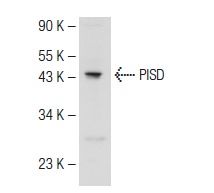
Western blot analysis of PISD expression in K-562 whole cell lysate.Application
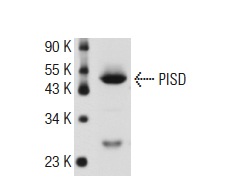
Western blot analysis of PISD expression in JAR whole cell lysate.Application
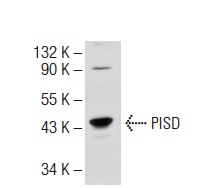
Western blot analysis of PISD expression in 293T whole cell lysate.| Product Name | PISD Antibody (E-15) |
|---|---|
| Antibody Type | Primary Antibodies |
| Antigen Alias | epitope mapping within an internal region of PISD of human origin |
| Modification Notes | Enzymes known as phosphatidylserine decarboxylases (PSDs) catalyze the formation of phosphatidylethanolamine from phosphatidylserine via phosphatidylserine decarboxylation. Type I PSDs contain LGST motifs and are found in bacteria and eukaryotic mitochondria, whereas type II PSDs contain GGST motifs and are found in eukaryotic endomembrane systems. PISD (phosphatidylserine decarboxylase), also known as phosphatidylserine decarboxylase proenzyme, PSDC, PSD, PSSC, DJ858B16, dJ858B16.2 or DKFZp566G2246, is a 408 amino acid a type I phosphatidylserine decarboxylase that localizes to the inner mitochondrial membrane. PISD contains a conserved LGST motif which is cleaved to produce two isoforms known as PISD alpha and PISD beta. PISD is capable of forming a heterodimer and is highly expressed in liver and testis. The gene encoding PISD maps to human chromosome 22q12.2. |
| Clonality | Polyclonal |
|---|---|
| Isotype | IgG |
| Host Species | Rabbit |
| Tested Applications | WBIPIFELISA |
| recommended for detection of PISD of mouse, rat and human origin by WB, IP, IF and ELISA also reactive with additional species, including canine, bovine, porcine and avian: |
|
| Species Reactivity | HumanMouseRat |
| Concentration | 1mg/ml |
| Purification | Affinity purified |
| Alternative Names | epitope mapping within an internal region of PISD of human origin |
|---|---|
| Tissue Specificity | epitope mapping within an internal region of PISD of human origin |
| Entrez Gene | 23761 |
|---|
Application
Western blot analysis of PISD expression in K-562 whole cell lysate.
Application
Western blot analysis of PISD expression in JAR whole cell lysate.
Application
Western blot analysis of PISD expression in 293T whole cell lysate.| Application Notes | recommended for detection of PISD of mouse, rat and human origin by WB, IP, IF and ELISA also reactive with additional species, including canine, bovine, porcine and avian: |
|---|
| Form | Liquid |
|---|---|
| Storage Instructions | For short-term storage, store at 4° C. For long-term storage, aliquot and store at -20ºC or below. Avoid multiple freeze-thaw cycles. |
| Storage Buffer | phosphate buffered saline , pH 7.4, 150mM NaCl, 0.02% sodium azide and 50% glycerol. |


