Application
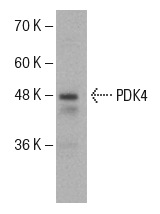
Western blot analysis of human PDK4 transfected 293T whole cell lysate.Application
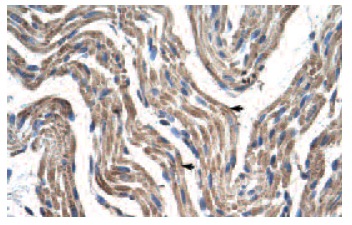
Immunoperoxidase staining of formalin-fixed, paraffin-embedded human muscle tissue showing cytoplasmic localization.| Product Name | PDK4 Antibody (E-24) |
|---|---|
| Antibody Type | Primary Antibodies |
| Antigen Alias | recommended for detection of PDK4 of human origin by WB, IP, IF, IHC(P) and ELISA |
| Modification Notes | Pyruvate dehydrogenase kinase family members (PDK1, 2, 3, 4) are serine kinases that catalyze phosphorylation of the E1å subunit of the pyruvate dehydrogenase complex (PDC). PDC activity is controlled through phosphorylation and dephosphorylation of the E1å subunit, which leads to inactivation and reactivation, respectively. Upregulation of PDK isoenzymes occurs during starvation conditions, where acetyl-CoA is alternatively generated through fatty acid oxidation. PDKs contain five conserved regions and are mechanistically similar to bacterial His-kinases since both require histidine residues for activity. In mammals, transcripts for PDK4 are most abundant in heart and skeletal muscle. PDK4 protein levels increase in starved or diabetic rat cardiac muscle and decrease upon re-feeding or insulin exposure, suggesting that PDK4 protein levels are important for long-term regulation of PDC activity in heart. |
| Clonality | Polyclonal |
|---|---|
| Isotype | IgG |
| Host Species | Rabbit |
| Tested Applications | WBIPIFIHCELISA |
| WB:1:500~1:2000 IP:1:100~1:500 IF:1:200~1:500 IHC:1:50~1:200 Notes:Optimal dilutions/concentrations should be determined by the researcher. |
|
| Species Reactivity | HumanMouseRat |
| Concentration | 1mg/ml |
| Purification | Affinity purified |
| Alternative Names | recommended for detection of PDK4 of human origin by WB IP IF IHC(P) and ELISA |
|---|---|
| Tissue Specificity | recommended for detection of PDK4 of human origin by WB, IP, IF, IHC(P) and ELISA |
| Entrez Gene | 5166 |
|---|
Application
Western blot analysis of human PDK4 transfected 293T whole cell lysate.
Application
Immunoperoxidase staining of formalin-fixed, paraffin-embedded human muscle tissue showing cytoplasmic localization.| Application Notes | WB:1:500~1:2000 IP:1:100~1:500 IF:1:200~1:500 IHC:1:50~1:200 Notes:Optimal dilutions/concentrations should be determined by the researcher. |
|---|
| Form | Liquid |
|---|---|
| Storage Instructions | For short-term storage, store at 4° C. For long-term storage, aliquot and store at -20ºC or below. Avoid multiple freeze-thaw cycles. |
| Storage Buffer | phosphate buffered saline , pH 7.4, 150mM NaCl, 0.02% sodium azide and 50% glycerol. |


