Application
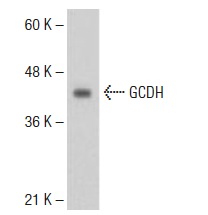
Western blot analysis of GCDH expression in Hep G2 whole cell lysate.Application
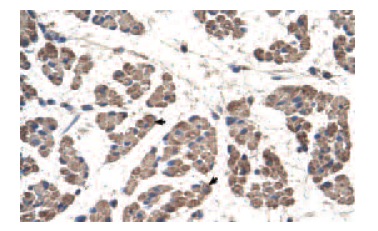
Immunoperoxidase staining of formalin-fixed, paraffin-embedded human muscle tissue showing cytoplasmic localization.| Product Name | GCDH Antibody (K-25) |
|---|---|
| Antibody Type | Primary Antibodies |
| Antigen Alias | recommended for detection of GCDH of mouse, rat, human and zebrafish origin by WB, IP, IF, IHC(P) and ELISA; also reactive with additional species, including canine |
| Modification Notes | GCDH (glutaryl-Coenzyme A dehydrogenase), also known as GCD or ACAD5, is a 438 amino acid protein that localizes to the mitochondrial matrix and belongs to the acyl-CoA dehydrogenase family. Existing as a homotetramer, GCDH uses FAD as a cofactor to catalyze the oxidative decarboxylation of glutaryl-CoA to crotonyl-CoA and CO(2) in the degradative pathway of L-lysine, L-hydroxylysine and L-tryptophan metabolism. While GCDH exists as both a long and short isoform, only the long isoform is a functionally active protein. Defects in the gene encoding GCDH are the cause of glutaric acidemia type I (GA-I), an autosomal recessive disorder that is characterized by the accumulation of glutaconic acid and is associated with such symptoms as progressive dystonia and athetosis due to gliosis and neuronal loss in the basal ganglia. |
| Clonality | Polyclonal |
|---|---|
| Isotype | IgG |
| Host Species | Rabbit |
| Tested Applications | WBIPIFIHCELISA |
| WB:1:500~1:2000 IP:1:100~1:500 IF:1:200~1:500 IHC:1:50~1:200 Notes:Optimal dilutions/concentrations should be determined by the researcher. |
|
| Species Reactivity | HumanMouseRat |
| Concentration | 1mg/ml |
| Purification | Affinity purified |
| Alternative Names | recommended for detection of GCDH of mouse rat human and zebrafish origin by WB IP IF IHC(P) and ELISA also reactive with additional species including canine |
|---|---|
| Tissue Specificity | recommended for detection of GCDH of mouse, rat, human and zebrafish origin by WB, IP, IF, IHC(P) and ELISA; also reactive with additional species, including canine |
| Entrez Gene | 2639 |
|---|
Application
Western blot analysis of GCDH expression in Hep G2 whole cell lysate.
Application
Immunoperoxidase staining of formalin-fixed, paraffin-embedded human muscle tissue showing cytoplasmic localization.| Application Notes | WB:1:500~1:2000 IP:1:100~1:500 IF:1:200~1:500 IHC:1:50~1:200 Notes:Optimal dilutions/concentrations should be determined by the researcher. |
|---|
| Form | Liquid |
|---|---|
| Storage Instructions | For short-term storage, store at 4° C. For long-term storage, aliquot and store at -20ºC or below. Avoid multiple freeze-thaw cycles. |
| Storage Buffer | phosphate buffered saline , pH 7.4, 150mM NaCl, 0.02% sodium azide and 50% glycerol. |


