Application
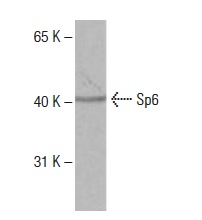
Western blot analysis of Sp6 expression in Jurkat whole cell lysate.| Product Name | Sp6 Antibody (J-25) |
|---|---|
| Antibody Type | Primary Antibodies |
| Antigen Alias | recommended for detection of Sp6 of mouse and human origin by WB, IP and ELISA |
| Modification Notes | Zinc-finger proteins contain DNA-binding domains and have a wide variety of functions, most of which encompass some form of transcriptional activation or repression. Sp6, also known as EPFN, EPIPROFIN or KLF14, is a 376 amino acid protein that localizes to the nucleus and contains three C2H2-type zinc fingers. Expressed ubiquitously with higher expression in developing teeth, hair follicles and limb buds, Sp6 functions to bind GC-rich sequences and related GT and CACCC boxes, thereby promoting cellular proliferation. Human Sp6 shares 96% sequence homology with its mouse counterpart, suggesting a conserved role between species. The gene encoding Sp6 maps to human chromosome 17, which comprises over 2.5% of the human genome and encodes over 1,200 genes. |
| Clonality | Polyclonal |
|---|---|
| Isotype | IgG |
| Host Species | Rabbit |
| Tested Applications | WBIPELISA |
| WB:1:500~1:2000 IP:1:100~1:500 Notes:Optimal dilutions/concentrations should be determined by the researcher. |
|
| Species Reactivity | HumanMouseRat |
| Concentration | 1mg/ml |
| Purification | Affinity purified |
| Alternative Names | recommended for detection of Sp6 of mouse and human origin by WB IP and ELISA |
|---|---|
| Tissue Specificity | recommended for detection of Sp6 of mouse and human origin by WB, IP and ELISA |
| Entrez Gene | 80320 |
|---|
Application
Western blot analysis of Sp6 expression in Jurkat whole cell lysate.| Application Notes | WB:1:500~1:2000 IP:1:100~1:500 Notes:Optimal dilutions/concentrations should be determined by the researcher. |
|---|
| Form | Liquid |
|---|---|
| Storage Instructions | For short-term storage, store at 4° C. For long-term storage, aliquot and store at -20ºC or below. Avoid multiple freeze-thaw cycles. |
| Storage Buffer | phosphate buffered saline , pH 7.4, 150mM NaCl, 0.02% sodium azide and 50% glycerol. |


