Application
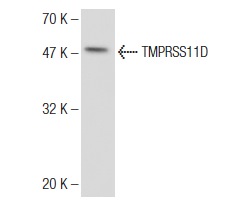
Western blot analysis of TMPRSS11D expression in 293T whole cell lysate.Application
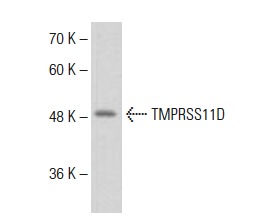
Western blot analysis of TMPRSS11D expression in Hep G2 whole cell lysate.| Product Name | TMPRSS11D Antibody (B-24) |
|---|---|
| Antibody Type | Primary Antibodies |
| Antigen Alias | recommended for detection of TMPRSS11D of human origin by WB, IP, IF, IHC(P) and ELISA |
| Modification Notes | TMPRSS11D (transmembrane protease, serine 11D), also known as HAT, is a 418 amino acid single-pass type II membrane protein that contains one SEA domain and one peptidase S1 domain. Expressed in bronchi and trachea, TMPRSS11D functions as a monomer that cleaves the C-terminal side of arginine residues at the P1 position of certain peptides and, via this catalytic activity, plays a role in the host defense system. TMPRSS11D is inhibited by diisopropyl fluorophosphate, leupeptin, antipain and aprotinin and is subject to post-translational cleavage which results in the formation of an active, secreted peptide. The gene encoding TMPRSS11D maps to human chromosome 4, which encodes nearly 6% of the human genome and has the largest gene deserts (regions of the genome with no protein encoding genes) of all of the human chromosomes. |
| Clonality | Polyclonal |
|---|---|
| Isotype | IgG |
| Host Species | Rabbit |
| Tested Applications | WBIPIFIHCELISA |
| WB:1:500~1:2000 IP:1:100~1:500 IF:1:200~1:500 IHC:1:50~1:200 Notes:Optimal dilutions/concentrations should be determined by the researcher. |
|
| Species Reactivity | HumanMouseRat |
| Concentration | 1mg/ml |
| Purification | Affinity purified |
| Alternative Names | recommended for detection of TMPRSS11D of human origin by WB IP IF IHC(P) and ELISA |
|---|---|
| Tissue Specificity | recommended for detection of TMPRSS11D of human origin by WB, IP, IF, IHC(P) and ELISA |
| Entrez Gene | 9407 |
|---|
Application
Western blot analysis of TMPRSS11D expression in 293T whole cell lysate.
Application
Western blot analysis of TMPRSS11D expression in Hep G2 whole cell lysate.| Application Notes | WB:1:500~1:2000 IP:1:100~1:500 IF:1:200~1:500 IHC:1:50~1:200 Notes:Optimal dilutions/concentrations should be determined by the researcher. |
|---|
| Form | Liquid |
|---|---|
| Storage Instructions | For short-term storage, store at 4° C. For long-term storage, aliquot and store at -20ºC or below. Avoid multiple freeze-thaw cycles. |
| Storage Buffer | phosphate buffered saline , pH 7.4, 150mM NaCl, 0.02% sodium azide and 50% glycerol. |


