Application
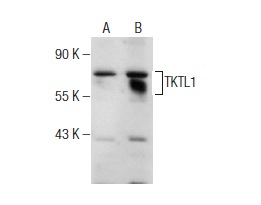
Western blot analysis of TKTL1 expression in non-transfected: (A) and human TKTL1 transfected: (B) 293T whole cell lysates.Application
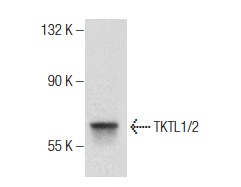
Western blot analysis of TKTL1/2 expression in MOLT-4 whole cell lysate.| Product Name | TKTL1/2 Antibody (M-83) |
|---|---|
| Antibody Type | Primary Antibodies |
| Antigen Alias | epitope corresponding to amino acids 215-297 mapping within an internal region of TKTL1 of mouse origin |
| Modification Notes | Transketolase, a crucial component of the pentose phosphate pathway (PPP), functions as a link between glycolysis and the non-oxidative part of the PPP, allowing the cell to adapt to varying metabolic conditions in response to environmental changes. TKTL1 (transketolase-like 1), also known as TKR or TKT2, is a 596 amino acid protein that localizes to both the nucleus and the cytoplasm and belongs to the Transketolase family. Expressed in both adult and fetal lung, brain, liver, heart and kidney, TKTL1 exists as a homodimer that uses calcium and thiamine pyrophosphate as cofactors to catalyze the conversion of sedoheptulose 7-phosphate and D-glyceraldehyde 3-phosphate to D-ribose 5-phosphate and D-xylulose 5-phosphate. Overexpression of TKTL1, which exists as multiple alternatively spliced isoforms, is associated with diabetic complications and epithelial tumor growth and invasion. TKTL2 (transketolase-like 2) is a 626 amino acid member of the Transketolase family that, like TKTL1, is able to catalyze a specific phosphate transfer reaction. |
| Clonality | Polyclonal |
|---|---|
| Isotype | IgG |
| Host Species | Rabbit |
| Tested Applications | WBIPIFELISA |
| recommended for detection of TKTL1 and TKTL2 of mouse, rat and, to a lesser extent, human origin by WB, IP, IF and ELISA: |
|
| Species Reactivity | HumanMouseRat |
| Concentration | 1mg/ml |
| Purification | Affinity purified |
| Alternative Names | epitope corresponding to amino acids 215-297 mapping within an internal region of TKTL1 of mouse origin |
|---|---|
| Tissue Specificity | epitope corresponding to amino acids 215-297 mapping within an internal region of TKTL1 of mouse origin |
| Entrez Gene | 8277 |
|---|
Application
Western blot analysis of TKTL1 expression in non-transfected: (A) and human TKTL1 transfected: (B) 293T whole cell lysates.
Application
Western blot analysis of TKTL1/2 expression in MOLT-4 whole cell lysate.| Application Notes | recommended for detection of TKTL1 and TKTL2 of mouse, rat and, to a lesser extent, human origin by WB, IP, IF and ELISA: |
|---|
| Form | Liquid |
|---|---|
| Storage Instructions | For short-term storage, store at 4° C. For long-term storage, aliquot and store at -20ºC or below. Avoid multiple freeze-thaw cycles. |
| Storage Buffer | phosphate buffered saline , pH 7.4, 150mM NaCl, 0.02% sodium azide and 50% glycerol. |


