Application
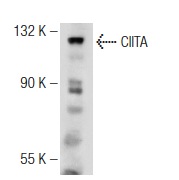
Western blot analysis of CIITA expression in Jurkat whole cell lysate.| Product Name | CIITA Antibody (H-300) |
|---|---|
| Antibody Type | Primary Antibodies |
| Antigen Alias | epitope corresponding to amino acids 831-1130 mapping at the C-terminus of CIITA of human origin |
| Modification Notes | The mounting of an immune response and CD4 T cell development in vertebrates require the expression of major histocompatibility complex (MHC) class II molecules. MHC class II molecules are heterodimeric cell surface glycoproteins expressed on B cells, macrophages and dendritic cells, which present antigens to CD4+ T cells. CIITA (class II transactivator) acts as a coactivator for MHC class II-specific gene expression and negatively regulates the IL-4 gene promoter during T cell differentiation. IFNg induces CIITA gene expression via JAK1 and Stat1 pathways. The GTP-binding and acidic, proline-serine-threonine-rich regions appear to be required for CIITA activity. RFX-B (also designated RFXANK and Tvl-1) is the smallest subunit of the RFX complex, which is also required for MHC class II-specific gene transcription. RFX-B contains three ankyrin-repeats that may allow protein-protein interactions between RFX-B and other RFX subunits, and possibly with CIITA and NF-Y. Defects of CIITA and RFX-B have been implicated as causes of Bare Lymphocyte Syndrome (BLS), which is characterized by the absence of MHC class II transcription and severe immunodeficiencies. |
| Clonality | Polyclonal |
|---|---|
| Isotype | IgG |
| Host Species | Rabbit |
| Tested Applications | WBIPIFELISAGSChIP |
| recommended for detection of CIITA of mouse, rat and human origin by WB, IP, IF and ELISA also reactive with additional species, including canine and bovine: |
|
| Species Reactivity | HumanMouseRat |
| Concentration | 1mg/ml |
| Purification | Affinity purified |
| Alternative Names | epitope corresponding to amino acids 831-1130 mapping at the C-terminus of CIITA of human origin |
|---|---|
| Tissue Specificity | epitope corresponding to amino acids 831-1130 mapping at the C-terminus of CIITA of human origin |
| Entrez Gene | 4261 |
|---|
Application
Western blot analysis of CIITA expression in Jurkat whole cell lysate.| Application Notes | recommended for detection of CIITA of mouse, rat and human origin by WB, IP, IF and ELISA also reactive with additional species, including canine and bovine: |
|---|
| Form | Liquid |
|---|---|
| Storage Instructions | For short-term storage, store at 4° C. For long-term storage, aliquot and store at -20ºC or below. Avoid multiple freeze-thaw cycles. |
| Storage Buffer | phosphate buffered saline , pH 7.4, 150mM NaCl, 0.02% sodium azide and 50% glycerol. |


