Application
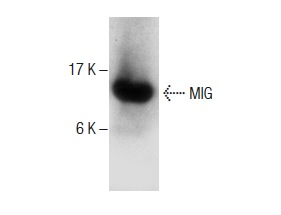
Western blot analysis of human recombinant MIG.| Product Name | MIG Antibody (H-40) |
|---|---|
| Antibody Type | Primary Antibodies |
| Antigen Alias | epitope corresponding to amino acids 28-67 mapping near the N-terminus of MIG of human origin |
| Modification Notes | MIG (monokine induced by interferon-gamma), also designated chemokine (C-X-C motif) ligand 9 (CXCL9), CMK, Humig, SCYB9 or crg-10, is a secreted C-X-C chemokine ligand involved in T cell trafficking; it can inhibit angiogenesis and displays thymus-dependent anti-tumor effects. Human carcinoma line HSC-2 expresses MIG mRNA in response to IFN-漏, whereas Ca9-22 and the glioma line A172 do not appear to express MIG mRNA. Elevation of serum MIG and CXCL10 in ocular sarcoidosis correlates with ocular disease activity and ACE (angiotensin converting enzyme) levels. The G氓 i protein-coupled receptor CXCR3 can bind MIG released from intestinal epithelium. MIG can block platelet activating factor (PAF)- or leukotriene B4 (LTB4)-induced responses and can inhibit eotaxin-induced filamentous Actin (F-Actin) formation and chemoattraction. MIG is one of many chemokines that belong to a group of small, mostly basic, structurally related molecules that regulate cell trafficking of various types of leukocytes through interactions with a subset of seven transmembrane, G protein-coupled receptors. |
| Clonality | Polyclonal |
|---|---|
| Isotype | IgG |
| Host Species | Rabbit |
| Tested Applications | WBIPIFELISA |
| recommended for detection of MIG of mouse, rat and human origin by WB, IP, IF and ELISA: |
|
| Species Reactivity | HumanMouseRat |
| Concentration | 1mg/ml |
| Purification | Affinity purified |
| Alternative Names | epitope corresponding to amino acids 28-67 mapping near the N-terminus of MIG of human origin |
|---|---|
| Tissue Specificity | epitope corresponding to amino acids 28-67 mapping near the N-terminus of MIG of human origin |
| Entrez Gene | 4283 |
|---|
Application
Western blot analysis of human recombinant MIG.| Application Notes | recommended for detection of MIG of mouse, rat and human origin by WB, IP, IF and ELISA: |
|---|
| Form | Liquid |
|---|---|
| Storage Instructions | For short-term storage, store at 4° C. For long-term storage, aliquot and store at -20ºC or below. Avoid multiple freeze-thaw cycles. |
| Storage Buffer | phosphate buffered saline , pH 7.4, 150mM NaCl, 0.02% sodium azide and 50% glycerol. |


