Application
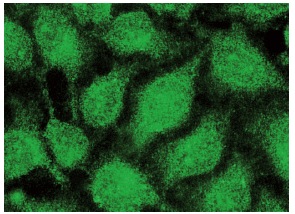
Immunofluorescence staining of methanol-fixed HeLa cells showing nuclear and cytoplasmic localization.| Product Name | HIRA Antibody (H-300) |
|---|---|
| Antibody Type | Primary Antibodies |
| Antigen Alias | epitope corresponding to amino acids 1-300 mapping at the N-terminus of HIRA of human origin |
| Modification Notes | HIRA is the human homolog of yeast Hir1p and Hir2p and is a widely expressed nuclear protein involved in cell cycle regulation. Specifically, HIRA is essential during development, possibly through the control of specific gene transcription programs. During development, HIRA is highly expressed in regions that contain neural crest cells. Cyclin dependent kinase 2 (Cdk-2) and Cyclin A bind with HIRA at an RXL motif which results in phosphorylation of the substrate at Thr 555. Ectopic expression of HIRA results in cell cycle arrest in S phase. HIRA also contains seven copies of a WD repeat and exhibits histone binding properties, suggesting that it may function as a regulator of histone gene expression. The gene encoding the 1017 amino acid HIRA maps to human chromosome 22q11, an area known to be the critical region of DiGeorge Syndrome (DGS). DGS is a congenital disease characterized by defects in tissues and organs, whose development depends on cell populations derived from the neural crest. |
| Clonality | Polyclonal |
|---|---|
| Isotype | IgG |
| Host Species | Rabbit |
| Tested Applications | WBIPIFELISA |
| recommended for detection of HIRA of mouse, rat and human origin by WB, IP, IF and ELISA also reactive with additional species, including canine and avian: |
|
| Species Reactivity | HumanMouseRat |
| Concentration | 1mg/ml |
| Purification | Affinity purified |
| Alternative Names | epitope corresponding to amino acids 1-300 mapping at the N-terminus of HIRA of human origin |
|---|---|
| Tissue Specificity | epitope corresponding to amino acids 1-300 mapping at the N-terminus of HIRA of human origin |
| Entrez Gene | 7290 |
|---|
Application
Immunofluorescence staining of methanol-fixed HeLa cells showing nuclear and cytoplasmic localization.| Application Notes | recommended for detection of HIRA of mouse, rat and human origin by WB, IP, IF and ELISA also reactive with additional species, including canine and avian: |
|---|
| Form | Liquid |
|---|---|
| Storage Instructions | For short-term storage, store at 4° C. For long-term storage, aliquot and store at -20ºC or below. Avoid multiple freeze-thaw cycles. |
| Storage Buffer | phosphate buffered saline , pH 7.4, 150mM NaCl, 0.02% sodium azide and 50% glycerol. |


