Application
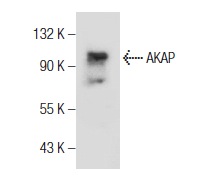
Western blot analysis of AKAP 3 expression in F9 whole cell lysate.| Product Name | AKAP 3 Antibody (H-50) |
|---|---|
| Antibody Type | Primary Antibodies |
| Antigen Alias | epitope corresponding to amino acids 781-830 mapping near the C-terminus of AKAP 3 of human origin |
| Modification Notes | The type II cAMP-dependent protein kinase (PKA) is a multifunctional kinase with a broad range of substrates. Specificity of PKA signaling is mediated by the compartmentalization of the kinase to specific sites within the cell. To maintain this specific localization, the R subunit (RII) of PKA interacts with specific RII-anchoring proteins, designated A-kinase anchoring proteins (AKAP). AKAP 3, also known as AKAP 110, FSP95, PRKA3 and SOB1, binds both PKA and PDE4A and functions as a scaffolding protein in spermatozoa to regulate local cAMP concentrations and modulate sperm functions. Expression of AKAP 3 in normal tissues is restricted to the testis, where bicarbonate stimulates tyrosine phosphorylation of AKAP 3, thereby increasing its recruitment of PKA. AKAP-3 also exhibits high expression in patients with epithelial ovarian cancer (EOC). It demonstrates tumor-restricted expression and appears to be associated with worse overall survival, which make AKAP 3 a potential target for antigen-specific immunotherapy in EOC. |
| Clonality | Polyclonal |
|---|---|
| Isotype | IgG |
| Host Species | Rabbit |
| Tested Applications | WBIPIFELISA |
| recommended for detection of AKAP 3 of mouse, rat and human origin by WB, IP, IF and ELISA also reactive with additional species, including equine, canine, bovine and porcine: |
|
| Species Reactivity | HumanMouseRat |
| Concentration | 1mg/ml |
| Purification | Affinity purified |
| Alternative Names | epitope corresponding to amino acids 781-830 mapping near the C-terminus of AKAP 3 of human origin |
|---|---|
| Tissue Specificity | epitope corresponding to amino acids 781-830 mapping near the C-terminus of AKAP 3 of human origin |
Application
Western blot analysis of AKAP 3 expression in F9 whole cell lysate.| Application Notes | recommended for detection of AKAP 3 of mouse, rat and human origin by WB, IP, IF and ELISA also reactive with additional species, including equine, canine, bovine and porcine: |
|---|
| Form | Liquid |
|---|---|
| Storage Instructions | For short-term storage, store at 4° C. For long-term storage, aliquot and store at -20ºC or below. Avoid multiple freeze-thaw cycles. |
| Storage Buffer | phosphate buffered saline , pH 7.4, 150mM NaCl, 0.02% sodium azide and 50% glycerol. |


