Application
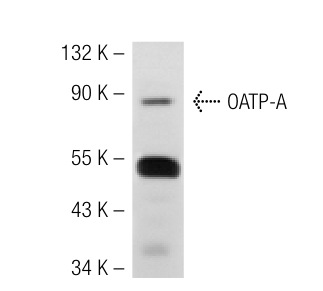
Western blot analysis of OATP-A expression in SK-N-MC whole cell lysate.| Product Name | OATP-A Antibody (H-55) |
|---|---|
| Antibody Type | Primary Antibodies |
| Modification Notes | The organic anion transporting polypeptides, OATP-A (also designated OATP1, OATP1A2 and SLC21A3) and OATP-C (also designated OATP2, SLC21A6 and LST1), mediate hepatic uptake of cardiac glycosides. The expression of OATP-C, but not OATP-A, is inducible by phenobarbital and pregnenolone-16a-carbonitrile, resulting in the increased capacity of the liver to extract cardiac glycosides from the plasma. OATP-A is expressed in liver and kidney and helps mediate sodium-independent uptake of the anionic steroid conjugates dehydroepiandrosterone sulfate, estradiol-17-glucuronide and prostaglandin. OATP-C is exclusively expressed in liver and is localized to the basolateral hepatocyte membrane. Although OATP-C mRNA levels decrease during pregnancy and increase postpartum, OATP-C protein levels remain relatively constant. OATP-C transports taurocholic acid, the adrenal androgen dehydroepiandroserone sulfate, thyroid hormone, hydroxymethylglutaryl-CoA reductase inhibitor and pravastatin. OATP-C is therefore a novel organic anion transport protein that has overlapping but not identical substrate specificities with other subtypes of OATP. OATP-A and OATP-C are both pravastatin transporters, suggesting that they are responsible for the hepatic uptake of the liver-specific hydroxymethylglutaryl-CoA reductase inhibitor in mouse, rat and human. |
| Clonality | Polyclonal |
|---|---|
| Isotype | IgG |
| Host Species | Rabbit |
| Tested Applications | WBIPIFELISA |
| recommended for detection of OATP-A of human origin by WB, IP, IF and ELISA | |
| Species Reactivity | HumanMouseRat |
| Concentration | 1mg/ml |
| Purification | Affinity purified |
| Alternative Names | epitope corresponding to amino acids 611-665 mapping near the C-terminus of OATP-A of human origin |
|---|---|
| Tissue Specificity | epitope corresponding to amino acids 611-665 mapping near the C-terminus of OATP-A of human origin |
| Entrez Gene | 6579 |
|---|
Application
Western blot analysis of OATP-A expression in SK-N-MC whole cell lysate.| Application Notes | recommended for detection of OATP-A of human origin by WB, IP, IF and ELISA |
|---|
| Form | Liquid |
|---|---|
| Storage Instructions | For short-term storage, store at 4° C. For long-term storage, aliquot and store at -20ºC or below. Avoid multiple freeze-thaw cycles. |
| Storage Buffer | phosphate buffered saline , pH 7.4, 150mM NaCl, 0.02% sodium azide and 50% glycerol. |


