Application
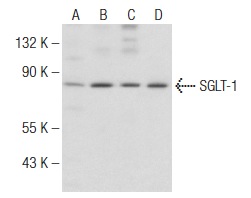
Western blot analysis of SGLT-1 expression in KNRK (A), MH-S (B), AMJ2-C8 (C) and NRK (D) whole cell lysates.| Product Name | SGLT-1 Antibody (H-85) |
|---|---|
| Antibody Type | Primary Antibodies |
| Modification Notes | Glucose is the main source of energy for mammalian cells and its entry is mediated by various transporters. Seven facilitative (GLUT-1 to -7) and 2 concentrative glucose transporters (SGLT-1 and -2) are identified. The Na+/glucose cotransporter gene SGLT-1 encodes the primary carrier protein responsible for the uptake of the dietary sugars glucose and galactose from the intestinal lumen. The glycoprotein is localized in the brush border of the intestinal epithelium and contains 12 membrane spans. SGLT-1 uses the electrochemical gradient of two sodium ions to transport one glucose molecule. Both the sodium glucose co-transporters SGLT-1 and -2 are also expressed in kidneys. The mRNA of SGLTs increases steadily from the fetal period to maturity along with the increase in their functional activity, i.e., glucose uptake. The interaction between a nucleocytoplasmic protein and a regulatory uridine-rich sequence in the 3'-UTR is important for cAMP-mediated SGLT-1 message stabilization. Defects in SGLT-1 cause Glucose-Galactose Malabsorption (GGM), resulting in neonatal onset of diarrhea, which results in death unless sugars are removed from the diet. |
| Clonality | Polyclonal |
|---|---|
| Isotype | IgG |
| Host Species | Rabbit |
| Tested Applications | WBIPIFELISA |
| recommended for detection of SGLT-1, and to a lesser extent, SGLT-4 of mouse, rat and human origin by WB, IP, IF and ELISA | |
| Species Reactivity | HumanMouseRat |
| Concentration | 1mg/ml |
| Purification | Affinity purified |
| Alternative Names | epitope corresponding to amino acids 580-657 mapping at the C-terminus of SGLT-1 of human origin |
|---|---|
| Tissue Specificity | epitope corresponding to amino acids 580-657 mapping at the C-terminus of SGLT-1 of human origin |
| Entrez Gene | 6523 |
|---|
Application
Western blot analysis of SGLT-1 expression in KNRK (A), MH-S (B), AMJ2-C8 (C) and NRK (D) whole cell lysates.| Application Notes | recommended for detection of SGLT-1, and to a lesser extent, SGLT-4 of mouse, rat and human origin by WB, IP, IF and ELISA |
|---|
| Form | Liquid |
|---|---|
| Storage Instructions | For short-term storage, store at 4° C. For long-term storage, aliquot and store at -20ºC or below. Avoid multiple freeze-thaw cycles. |
| Storage Buffer | phosphate buffered saline , pH 7.4, 150mM NaCl, 0.02% sodium azide and 50% glycerol. |


