Application
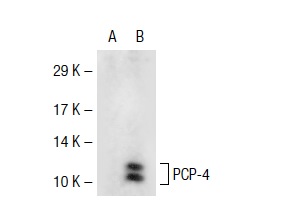
Western blot analysis of PCP-4 expression in non-transfected: (A) and human PCP-4 transfected: (B) 293T whole cell lysates.| Product Name | PCP-4 Antibody (Q-20) |
|---|---|
| Antibody Type | Primary Antibodies |
| Modification Notes | PCP-4 (Purkinje cell protein 4), also known as PEP-19, is a calmodulin (CaM) regulatory protein that is highly expressed in neuronal cells. Through its IQ motif, PCP-4 mediates both the calcium-dependent binding properties of CaM and the rates of association and dissociation of calcium from the C-terminal domain of CaM. The IQ motif contains a serine residue which can be phosphorylated by all isoforms of protein kinase C (PKC). PCP-4 is implicated in uterine leiomyomas, as well as in neurodegenerative disorders such as Alzheimer’s disease and Huntington's disease. Additionally, overexpression of PCP-4 is thought to play a role in cerebellar hypoplasia, a key feature of Down syndrome. |
| Clonality | Polyclonal |
|---|---|
| Isotype | IgG |
| Host Species | Rabbit |
| Tested Applications | WBIPIFELISA |
| recommended for detection of PCP-4 of mouse, rat and human origin by WB,IP, IF and ELISA also reactive with additional species, including canine, bovine and avian | |
| Species Reactivity | HumanMouseRat |
| Concentration | 1mg/ml |
| Purification | Affinity purified |
| Alternative Names | epitope mapping at the N-terminus of PCP-4 of human origin |
|---|---|
| Tissue Specificity | epitope mapping at the N-terminus of PCP-4 of human origin |
| Entrez Gene | 5121 |
|---|
Application
Western blot analysis of PCP-4 expression in non-transfected: (A) and human PCP-4 transfected: (B) 293T whole cell lysates.| Application Notes | recommended for detection of PCP-4 of mouse, rat and human origin by WB,IP, IF and ELISA also reactive with additional species, including canine, bovine and avian |
|---|
| Form | Liquid |
|---|---|
| Storage Instructions | For short-term storage, store at 4° C. For long-term storage, aliquot and store at -20ºC or below. Avoid multiple freeze-thaw cycles. |
| Storage Buffer | phosphate buffered saline , pH 7.4, 150mM NaCl, 0.02% sodium azide and 50% glycerol. |


