Application
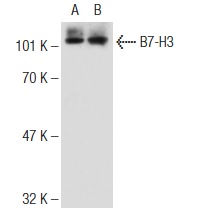
Western blot analysis of B7-H3 expression in JAR (A) and JEG-3 (B) whole cell lysates.Application
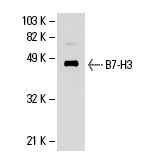
Western blot analysis of mouse recombinant B7-H3.| Product Name | B7-H3 Antibody (H-300) |
|---|---|
| Antibody Type | Primary Antibodies |
| Modification Notes | T cell activation and immune function are regulated by the innate immune system through positive and negative costimulatory molecules. One such molecule, B7-H3 (B7-homolog 3, also designated B7RP-2) belongs to the B7 Immunoglobulin superfamily. Soluble B7-H3 binds a putative receptor on activated T-cells that is distinct from CD28, CTLA-4, ICOS and PD-1. Widely expressed on nonlymphoid tissues, B7-H3 costimulates proliferation of both CD4+ and CD8+ T cells. The ability of B7-H3 to stimulate Th1 and cytotoxic-T cell responses suggest that it may have antitumor activity. B7-H3 interactions may play a role in regulating cell-mediated immune responses against cancer, implicating B7-H3 as a potential therapeutic tool. |
| Clonality | Polyclonal |
|---|---|
| Isotype | IgG |
| Host Species | Rabbit |
| Tested Applications | WBIPIFELISA |
| recommended for detection of B7-H3 of mouse, rat and human origin by WB, IP, IF and ELISA also reactive with additional species, including canine and bovine | |
| Species Reactivity | HumanMouseRat |
| Concentration | 1mg/ml |
| Purification | Affinity purified |
| Alternative Names | epitope corresponding to amino acids 166-465 mapping within an N-terminal extracellular domain of B7-H3 of human origin |
|---|---|
| Tissue Specificity | epitope corresponding to amino acids 166-465 mapping within an N-terminal extracellular domain of B7-H3 of human origin |
| Entrez Gene | 80381 |
|---|
Application
Western blot analysis of B7-H3 expression in JAR (A) and JEG-3 (B) whole cell lysates.
Application
Western blot analysis of mouse recombinant B7-H3.| Application Notes | recommended for detection of B7-H3 of mouse, rat and human origin by WB, IP, IF and ELISA also reactive with additional species, including canine and bovine |
|---|
| Form | Liquid |
|---|---|
| Storage Instructions | For short-term storage, store at 4° C. For long-term storage, aliquot and store at -20ºC or below. Avoid multiple freeze-thaw cycles. |
| Storage Buffer | phosphate buffered saline , pH 7.4, 150mM NaCl, 0.02% sodium azide and 50% glycerol. |


