Application
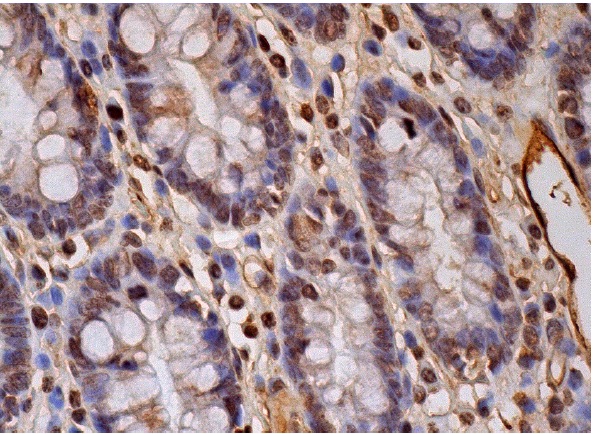
Immunoperoxidase staining of formalin fixed, paraffin-embedded human colon tissue showing nuclear staining of glandular cells and nuclear and cytoplasmic staining of endothelial cells.| Product Name | Sororin Antibody (M-190) |
|---|---|
| Antibody Type | Primary Antibodies |
| Antigen Alias | epitope corresponding to amino acids 1-190 mapping at the N-terminus of Sororin of mouse origin |
| Modification Notes | Sororin, also designated cell division cycle-associated protein 5 (CDCA5) or p35, functions as a regulator of sister chromatid cohesion during mitosis. It interacts with the APC/C complex and is found in a complex consisting of cohesion components SCC-112, MC1L1, SMC3L1, RAD21 and APRIN. The deduced human and mouse Sororin proteins consist of 252 and 264 amino acid residues, respectively, and both contain a KEN box for APC-dependent ubiquitination. Reserach demonstrates a punctated nuclear distribution of Sororin during interphase and a diffuse distribution throughout the cell during mitosis. There is no apparent concentration of Sororin on chromatin in mitotic cells and Sororin levels decrease in synchronized HeLa cells during interphase. The Sororin gene maps to chromosome 11q12.1. |
| Clonality | Polyclonal |
|---|---|
| Isotype | IgG |
| Host Species | Rabbit |
| Tested Applications | WBIPIFIHCELISA |
| recommended for detection of Sororin (CDCA5) of mouse, rat and, to a lesser extent, human origin by WB, IP, IF, IHC(P) and ELISA: |
|
| Species Reactivity | HumanMouseRat |
| Concentration | 1mg/ml |
| Purification | Affinity purified |
| Alternative Names | epitope corresponding to amino acids 1-190 mapping at the N-terminus of Sororin of mouse origin |
|---|---|
| Tissue Specificity | epitope corresponding to amino acids 1-190 mapping at the N-terminus of Sororin of mouse origin |
| Entrez Gene | 113130 |
|---|
Application
Immunoperoxidase staining of formalin fixed, paraffin-embedded human colon tissue showing nuclear staining of glandular cells and nuclear and cytoplasmic staining of endothelial cells.| Application Notes | recommended for detection of Sororin (CDCA5) of mouse, rat and, to a lesser extent, human origin by WB, IP, IF, IHC(P) and ELISA: |
|---|
| Form | Liquid |
|---|---|
| Storage Instructions | For short-term storage, store at 4° C. For long-term storage, aliquot and store at -20ºC or below. Avoid multiple freeze-thaw cycles. |
| Storage Buffer | phosphate buffered saline , pH 7.4, 150mM NaCl, 0.02% sodium azide and 50% glycerol. |


