Application
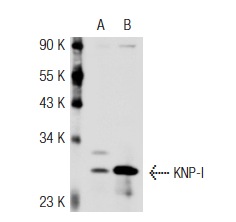
Western blot analysis of KNP-I expression in mouse heart (A) and rat skeletal muscle (B) tissue extracts.| Product Name | KNP-I Antibody (K-18) |
|---|---|
| Antibody Type | Primary Antibodies |
| Modification Notes | KNP-I (ES1 protein homolog, protein GT335) is a ubiquitously expressed mitochondrial protein that belongs to the ES1 family of proteins. It is a highly conserved protein with homologs identified in various species. This conserved nature suggests an important biological role for the KNP-I protein. The gene that encodes KNP-I (C21orf33) is located on human chromosome 21 in close proximity to a region (D21S25) associated with many genetic diseases. Down syndrome (DS), caused by an extra copy of chromosome 21, is the most common manifestation of trisomic chromosomes. It is likely that the overproduction of the C21orf33 gene product plays a role in the pathology of DS, while its chromosomal location suggests its likely involvement in D21S25 related diseases. While expressed in most tissue, highest expression of KNP-I is found in heart and muscle. |
| Clonality | Polyclonal |
|---|---|
| Isotype | IgG |
| Host Species | Rabbit |
| Tested Applications | WBIFELISA |
| recommended for detection of KNP-I of human origin and, to a lesser extent, D10Jhu81e of mouse origin and the corresponding rat homolog by WB, IF and ELISA also reactive with additional species, including equine, canine, bovine and porcine | |
| Species Reactivity | HumanMouseRat |
| Concentration | 1mg/ml |
| Purification | Affinity purified |
| Alternative Names | epitope mapping within an internal region of KNP-I of human origin |
|---|---|
| Tissue Specificity | epitope mapping within an internal region of KNP-I of human origin |
| Entrez Gene | 8209 |
|---|
Application
Western blot analysis of KNP-I expression in mouse heart (A) and rat skeletal muscle (B) tissue extracts.| Application Notes | recommended for detection of KNP-I of human origin and, to a lesser extent, D10Jhu81e of mouse origin and the corresponding rat homolog by WB, IF and ELISA also reactive with additional species, including equine, canine, bovine and porcine |
|---|
| Form | Liquid |
|---|---|
| Storage Instructions | For short-term storage, store at 4° C. For long-term storage, aliquot and store at -20ºC or below. Avoid multiple freeze-thaw cycles. |
| Storage Buffer | phosphate buffered saline , pH 7.4, 150mM NaCl, 0.02% sodium azide and 50% glycerol. |


