Application
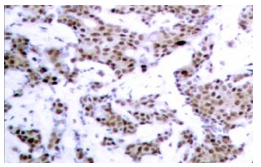
Immunoperoxidase staining of formalin-fixed, paraffin-embedded human breast carcinoma tissue showing nuclear localization.| Product Name | p-MEF-2 Antibody (Thr 312) |
|---|---|
| Antibody Type | Primary Antibodies |
| Modification Notes | Myogenic helix-loop-helix (HLH) transcription factors of the myogenin/MyoD class have been studied in detail over the past few years (1–4). Muscle gene induction by these proteins depends upon sequence-specific DNA binding at the E box DNA element present in many muscle enhancers and promoters (1–4). MEF-2 is a muscle-specific DNA binding protein that recognizes an A+T-rich sequence [CTA (A/T)4 TAG] localized in the control regions of numerous muscle-specific genes (5,6). MEF-2 belongs to the MADS (MCM1, Agamous, Deficiens and serum-response factor) box family of transcription factors (5). The MEF-2 proteins comprise several alternatively spliced isoforms from the MEF-2 gene and a related factor encoded by the related gene xMEF2 (7). MEF2 expression is ubiquitous but preferential in skeletal and cardiac muscle cells (7,8). The serine 59 residue, located between the MADS and MEF2 domains of MEF-2C, is phosphorylated in vivo and can be phosphorylated in vitro by casein kinase-II (CKII) (9). Phosphorylation of this site enhances the DNA binding and transcriptional activity of MEF-2C by increasing its DNA binding activity 5-fold (2). |
| Clonality | Polyclonal |
|---|---|
| Isotype | IgG |
| Host Species | Rabbit |
| Tested Applications | IFIHC |
| recommended for detection of Thr 312 phosphorylated MEF-2 of human origin and correspondingly phosphorylated Thr 310 of mouse and rat origin by IF and IHC(P) | |
| Species Reactivity | HumanMouseRat |
| Concentration | 1mg/ml |
| Purification | Affinity purified |
| Alternative Names | epitope corresponding to phosphorylated Thr 312 of MEF-2 of human origin |
|---|---|
| Tissue Specificity | epitope corresponding to phosphorylated Thr 312 of MEF-2 of human origin |
| Entrez Gene | 4205 |
|---|
Application
Immunoperoxidase staining of formalin-fixed, paraffin-embedded human breast carcinoma tissue showing nuclear localization.| Application Notes | recommended for detection of Thr 312 phosphorylated MEF-2 of human origin and correspondingly phosphorylated Thr 310 of mouse and rat origin by IF and IHC(P) |
|---|
| Form | Liquid |
|---|---|
| Storage Instructions | For short-term storage, store at 4° C. For long-term storage, aliquot and store at -20ºC or below. Avoid multiple freeze-thaw cycles. |
| Storage Buffer | phosphate buffered saline , pH 7.4, 150mM NaCl, 0.02% sodium azide and 50% glycerol. |


