Application
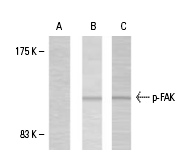
Blots were probed with p-FAK (Tyr 925): preincubated with cognate phosphorylated peptide (A) and p-FAK (Tyr 925): (B,C,D).| Product Name | p-FAK Antibody (Tyr 925) |
|---|---|
| Antibody Type | Primary Antibodies |
| Modification Notes | Activation of integrins in the extracellular matrix (ECM) of eukaryotic cells promotes the formation of membrane adhesion complexes, known as focal adhesions, which can include cytoskeletal proteins and protein tyrosine kinases, such as focal adhesion kinase (FAK). Phosphorylation events occurring within focal adhesions influence numerous processes that include mitogenic signaling, cell survival and cell motility. FAK is a non-receptor tyrosine kinase that is ubiquitously expressed and highly conserved between species. FAK is recruited by integrin clusters and variably phosphorylated depending on the effector molecules present in the focal adhesion. Phospho-rylation of FAK Tyr 397 decreases during serum starvation, contact inhibition and cell cycle arrest, all conditions under which activating FAK Tyr 407 phosphorylation increases. |
| Clonality | Polyclonal |
|---|---|
| Isotype | IgG |
| Host Species | Rabbit |
| Tested Applications | WBIP |
| recommended for detection of Tyr 925 phosphorylated FAK of human origin, correspondingly phosphorylated Tyr 963 of mouse origin and correspondingly phosphorylated Tyr 928 of rat origin by WB and IP | |
| Species Reactivity | HumanMouseRat |
| Concentration | 1mg/ml |
| Purification | Affinity purified |
| Alternative Names | epitope corresponding to phosphorylated Tyr 925 of FAK of human origin |
|---|---|
| Tissue Specificity | epitope corresponding to phosphorylated Tyr 925 of FAK of human origin |
| Entrez Gene | 5747 |
|---|
Application
Blots were probed with p-FAK (Tyr 925): preincubated with cognate phosphorylated peptide (A) and p-FAK (Tyr 925): (B,C,D).| Application Notes | recommended for detection of Tyr 925 phosphorylated FAK of human origin, correspondingly phosphorylated Tyr 963 of mouse origin and correspondingly phosphorylated Tyr 928 of rat origin by WB and IP |
|---|
| Form | Liquid |
|---|---|
| Storage Instructions | For short-term storage, store at 4° C. For long-term storage, aliquot and store at -20ºC or below. Avoid multiple freeze-thaw cycles. |
| Storage Buffer | phosphate buffered saline , pH 7.4, 150mM NaCl, 0.02% sodium azide and 50% glycerol. |


