Application
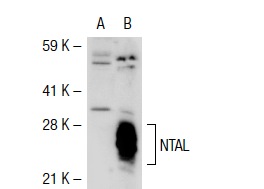
Western blot analysis of NTAL expression in non-transfected: (A) and mouse NTAL transfected: (B) 293T whole cell lysates.| Product Name | NTAL Antibody (M-66) |
|---|---|
| Antibody Type | Primary Antibodies |
| Modification Notes | Non-T cell activation linker (NTAL), a transmembrane adaptor protein, is also designated membrane-associated adapter molecule, Williams-Beuren syndrome chromosome region 15 protein or LAB (linker of activated B cells). NTAL is present in membrane microdomains (rafts) of B cells, NK cells and myeloid cells, and in monocytes and mast cells, but not in resting T lymphocytes. NTAL becomes rapidly tyrosine-phosphorylated upon cross-linking of the B cell receptor (BCR) or of high-affinity Fc g and Fc e receptors of myeloid cells and then associates with the cytoplasmic signaling molecules. NTAL is highly expressed in spleen, lymph node germinal centers and peripheral blood lymphocytes. Defects in the gene encoding for NTAL may cause the musculo-skeletal and cardio-vascular abnormalities that characterize the rare developmental disorder Williams-Beuren syndrome (WBS). |
| Clonality | Polyclonal |
|---|---|
| Isotype | IgG |
| Host Species | Rabbit |
| Tested Applications | WBIPIFELISA |
| recommended for detection of non-T-cell activation linker of mouse and rat origin by WB, IP, IF and ELISA | |
| Species Reactivity | HumanMouseRat |
| Concentration | 1mg/ml |
| Purification | Affinity purified |
| Alternative Names | epitope corresponding to amino acids 69-134 mapping within an internal region of NTAL of mouse origin |
|---|---|
| Tissue Specificity | epitope corresponding to amino acids 69-134 mapping within an internal region of NTAL of mouse origin |
| Entrez Gene | 56743 |
|---|
Application
Western blot analysis of NTAL expression in non-transfected: (A) and mouse NTAL transfected: (B) 293T whole cell lysates.| Application Notes | recommended for detection of non-T-cell activation linker of mouse and rat origin by WB, IP, IF and ELISA |
|---|
| Form | Liquid |
|---|---|
| Storage Instructions | For short-term storage, store at 4° C. For long-term storage, aliquot and store at -20ºC or below. Avoid multiple freeze-thaw cycles. |
| Storage Buffer | phosphate buffered saline , pH 7.4, 150mM NaCl, 0.02% sodium azide and 50% glycerol. |


