Application
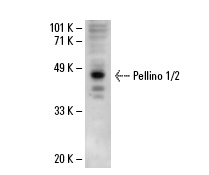
Western blot analysis of Pellino 1/2 expression in HeLa whole cell lysate.| Product Name | Pellino 1/2 Antibody (H-105) |
|---|---|
| Antibody Type | Primary Antibodies |
| Antigen Alias | epitope corresponding to amino acids 151-255 mapping within an internal region of Pellino 1 of human origin |
| Modification Notes | Mammalian Pellino proteins 1-3 (pellino Drosophila homolog 1-3) are scaffolding components within Toll-like receptor (TLR) and Interleukin-1 (IL-1) receptor signaling cascades. Pellino 1 and 3 interact with complexes that also contain IL-1R-associated kinase 4 (IRAK4) and tumor necrosis factor receptor-associated factor 6 (TRAF6). Pellino 1, 2 and 3 interact with TAK1 (TGF∫ activated kinase 1). Pellino 2 can initiate mitogen activated protein kinase (MAPK) pathways leading to activation of AP-1 and Elk-1. Pellino 3 promotes translocation of MAPK-activated protein kinase 2 from the nucleus to the cytoplasm and activates transcription factor CREB in a p38 MAPK-dependent manner. Pellino 3 physically interacts with NF˚B-inducing kinase (NIK) in an IL-1-dependent manner and leads to activation of c-Jun, Elk-1 and c-Jun N-terminal kinase. |
| Clonality | Polyclonal |
|---|---|
| Isotype | IgG |
| Host Species | Rabbit |
| Tested Applications | WBIPIFELISA |
| recommended for detection of Pellino 1 and 2 of mouse, rat and human origin by WB, IP, IF and ELISA may cross-react with Pellino 3 also reactive with additional species, including equine, canine, bovine, porcine and avian: |
|
| Species Reactivity | HumanMouseRat |
| Concentration | 1mg/ml |
| Purification | Affinity purified |
| Alternative Names | epitope corresponding to amino acids 151-255 mapping within an internal region of Pellino 1 of human origin |
|---|---|
| Tissue Specificity | epitope corresponding to amino acids 151-255 mapping within an internal region of Pellino 1 of human origin |
| Entrez Gene | 57161 |
|---|
Application
Western blot analysis of Pellino 1/2 expression in HeLa whole cell lysate.| Application Notes | recommended for detection of Pellino 1 and 2 of mouse, rat and human origin by WB, IP, IF and ELISA may cross-react with Pellino 3 also reactive with additional species, including equine, canine, bovine, porcine and avian: |
|---|
| Form | Liquid |
|---|---|
| Storage Instructions | For short-term storage, store at 4° C. For long-term storage, aliquot and store at -20ºC or below. Avoid multiple freeze-thaw cycles. |
| Storage Buffer | phosphate buffered saline , pH 7.4, 150mM NaCl, 0.02% sodium azide and 50% glycerol. |


