Application
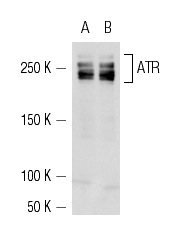
Western blot analysis of ATR expression in HeLa whole cell lysate (A) and HeLa nuclear extract (B).Application
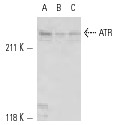
Western blot analysis of ATR expression in HeLa (A), A-431 (B) and ECV304 (C) whole cell lysates.| Product Name | ATR Antibody (H-300) |
|---|---|
| Antibody Type | Primary Antibodies |
| Antigen Alias | epitope corresponding to amino acids 1-300 of ATR of human origin |
| Modification Notes | Members of the PIK (phosphatidylinositol kinase)-related kinase family are high molecular weight kinases involved in cell cycle progression, DNA recombination and detection of DNA damage. One member of the PI 3-/PI 4-kinase family is ATR (ataxia-telangiectasia- and Rad3-related), also known as FRP1 (for FRAP-related protein 1). ATR is most closely related to ATM, a protein kinase encoded by the gene mutated in ataxia telangiectasia. ATR is also closely related to three of the family members involved in checkpoint function: Mei-41 (Drosophila), Mec1p (S. cerevisiae) and Rad3 (Schizosaccharo?myces pombe), and as such may be the functional human counterpart of these proteins. This kinase has been shown to phosphorylate checkpoint kinase CHK1, checkpoint proteins Rad17 and Rad9, as well as tumor suppressor protein BRCA1. In addition, ATR is essential for early embryonic development. The protein encoded by the human ATR gene localizes to intranuclear foci after DNA damage or inhibition of replication. |
| Clonality | Polyclonal |
|---|---|
| Isotype | IgG |
| Host Species | Rabbit |
| Tested Applications | WBIPIFELISA |
| recommended for detection of ATR of mouse, rat and human origin by WB, IP, IF and ELISA also reactive with additional species, including canine and porcine: |
|
| Species Reactivity | HumanMouseRat |
| Concentration | 1mg/ml |
| Purification | Affinity purified |
| Alternative Names | epitope corresponding to amino acids 1-300 of ATR of human origin |
|---|---|
| Tissue Specificity | epitope corresponding to amino acids 1-300 of ATR of human origin |
| Entrez Gene | 545 |
|---|
Application
Western blot analysis of ATR expression in HeLa whole cell lysate (A) and HeLa nuclear extract (B).
Application
Western blot analysis of ATR expression in HeLa (A), A-431 (B) and ECV304 (C) whole cell lysates.| Application Notes | recommended for detection of ATR of mouse, rat and human origin by WB, IP, IF and ELISA also reactive with additional species, including canine and porcine: |
|---|
| Form | Liquid |
|---|---|
| Storage Instructions | For short-term storage, store at 4° C. For long-term storage, aliquot and store at -20ºC or below. Avoid multiple freeze-thaw cycles. |
| Storage Buffer | phosphate buffered saline , pH 7.4, 150mM NaCl, 0.02% sodium azide and 50% glycerol. |


