Application
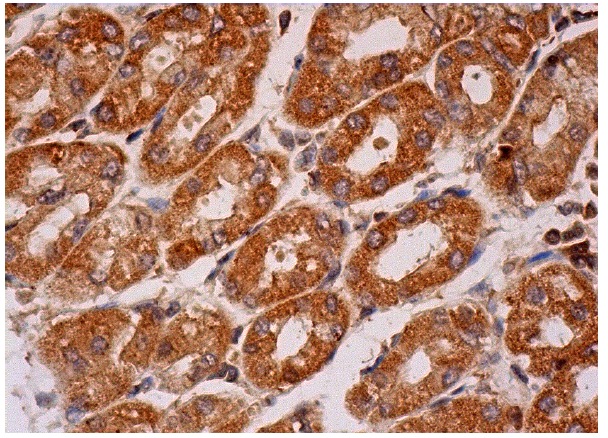
Immunoperoxidase staining of formalin fixed, paraffin-embedded human upper stomach tissue showing cytoplasmic staining of glandular cells.| Product Name | ACCβ Antibody (H-220) |
|---|---|
| Antibody Type | Primary Antibodies |
| Antigen Alias | epitope corresponding to amino acids 146-220 mapping near the N-terminus of ACCβ of human origin |
| Modification Notes | Acetyl-CoA carboxylase (ACC) is a complex multifunctional enzyme system which catalyzes the carboxylation of acetyl-CoA to malonyl-CoA, the rate-limiting step in fatty acid synthesis. Exercise diminishes the activity of acetyl-CoA carboxylase in human muscle. ACC? (ACC1) is the rate-limiting enzyme in the biogenesis of long-chain fatty acids, and ACC? (ACC2) is thought to control mitochondrial fatty acid oxidation. These two isoforms of ACC control the amount of fatty acids in the cells. ACCb is thought to control fatty acid oxidation by means of the ability of malonyl-CoA to inhibit carnitine-palmitoyl-CoA transferase I, the rate-limiting step in fatty acid uptake and oxidation by mitochondria. The gene encoding ACC? maps to human chromosome 12 and encodes a mitochondiral protein expressed in heart and skeletal muscle. The catalytic core of ACC? is homologous to that of ACC?, except for an additional peptide of about 150 amino acids at the N-terminus. |
| Clonality | Polyclonal |
|---|---|
| Isotype | IgG |
| Host Species | Rabbit |
| Tested Applications | WBIPIFIHCELISA |
| recommended for detection of ACCβ of human origin by WB, IP, IF, IHC(P) and ELISA: |
|
| Species Reactivity | HumanMouseRat |
| Concentration | 1mg/ml |
| Purification | Affinity purified |
| Alternative Names | epitope corresponding to amino acids 146-220 mapping near the N-terminus of ACC&beta of human origin |
|---|---|
| Tissue Specificity | epitope corresponding to amino acids 146-220 mapping near the N-terminus of ACCβ of human origin |
| Entrez Gene | 32 |
|---|
Application
Immunoperoxidase staining of formalin fixed, paraffin-embedded human upper stomach tissue showing cytoplasmic staining of glandular cells.| Application Notes | recommended for detection of ACCβ of human origin by WB, IP, IF, IHC(P) and ELISA: |
|---|
| Form | Liquid |
|---|---|
| Storage Instructions | For short-term storage, store at 4° C. For long-term storage, aliquot and store at -20ºC or below. Avoid multiple freeze-thaw cycles. |
| Storage Buffer | phosphate buffered saline , pH 7.4, 150mM NaCl, 0.02% sodium azide and 50% glycerol. |


