Application
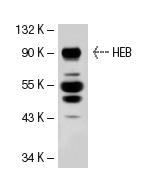
Western blot analysis of HEB expression in Jurkat whole cell lysate.| Product Name | HEB Antibody (H-130) |
|---|---|
| Antibody Type | Primary Antibodies |
| Antigen Alias | epitope corresponding to amino acids 31-160 of HEB of human origin |
| Modification Notes | Differentiation of myogenic cells is regulated by multiple positively and negatively acting factors. One well characterized family of helix-loop-helix (HLH) proteins known to play an important role in the regulation of muscle cell development includes Myo D, myogenin (1), Myf-5 (2) and Myf-6 (also designated MRF-4 or herculin) (3,4). Myo D transcription factors form heterodimers with products of a more widely expressed family of bHLH genes, the E family, which consists of at least three distinct genes: E2A, IF2 and HEB (5-8). Myo D-E heterodimers bind avidly to consensus (CANNTG) E box target sites that are functionally important elements in the upstream regulatory sequences of many muscle-specific terminal differentiation genes (5-8). Both homo- and hetero-oligomers of these proteins are able to distinguish very closely related E box proteins and are believed to play important roles in lineage specific gene expression. |
| Clonality | Polyclonal |
|---|---|
| Isotype | IgG |
| Host Species | Rabbit |
| Tested Applications | WBIPIFELISAGSChIP |
| recommended for detection of HEB of mouse, rat and human origin by WB, IP, IF and ELISA also reactive with additional species, including equine, canine, bovine and porcine: |
|
| Species Reactivity | HumanMouseRat |
| Concentration | 1mg/ml |
| Purification | Affinity purified |
| Alternative Names | epitope corresponding to amino acids 31-160 of HEB of human origin |
|---|---|
| Tissue Specificity | epitope corresponding to amino acids 31-160 of HEB of human origin |
| Entrez Gene | 6938 |
|---|
Application
Western blot analysis of HEB expression in Jurkat whole cell lysate.| Application Notes | recommended for detection of HEB of mouse, rat and human origin by WB, IP, IF and ELISA also reactive with additional species, including equine, canine, bovine and porcine: |
|---|
| Form | Liquid |
|---|---|
| Storage Instructions | For short-term storage, store at 4° C. For long-term storage, aliquot and store at -20ºC or below. Avoid multiple freeze-thaw cycles. |
| Storage Buffer | phosphate buffered saline , pH 7.4, 150mM NaCl, 0.02% sodium azide and 50% glycerol. |


