Application
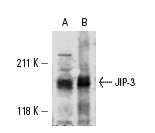
Western blot analysis of JIP-3 expression in PC-12 whole cell lysate (A) and rat brain tissue extract (B).| Product Name | JIP-3 Antibody (H-140) |
|---|---|
| Antibody Type | Primary Antibodies |
| Antigen Alias | epitope corresponding to amino acids 211-350 of JIP-3 of human origin |
| Modification Notes | The JNK-interacting proteins (JIPs) are a family of scaffold proteins that mediate JNK signaling by organizing specific components of the MAPK cascade together to form a functional JNK signaling molecule. JIP-3 (JNK-interacting protein 3), also known as JSAP1 or MAPK8IP3 (Mitogen-activated protein kinase 8-interacting protein 3), is a 1,336 amino acid protein that localizes to the cytoplasm and belongs to the JIP family. Expressed in a variety of tissues, including brain and heart, JIP-3 forms homo- or heterooligomeric complexes that can interact with several components of the JNK signaling pathway, thereby functioning as a regulator of kinesin-dependent axonal transport that may also play a role in scaffold formation within neuronal cells. Human JIP-3, which may be phosphorylated upon DNA damage, shares 69% similarity with its mouse counterpart, suggesting a conserved role between species. Multiple isoforms of JIP-3 exist due to alternative splicing events. |
| Clonality | Polyclonal |
|---|---|
| Isotype | IgG |
| Host Species | Rabbit |
| Tested Applications | WBIPIFELISA |
| recommended for detection of JIP-3 of mouse, rat and human origin by WB, IP, IF and ELISA also reactive with additional species, including equine, canine, bovine, porcine and avian: |
|
| Species Reactivity | HumanMouseRat |
| Concentration | 1mg/ml |
| Purification | Affinity purified |
| Alternative Names | epitope corresponding to amino acids 211-350 of JIP-3 of human origin |
|---|---|
| Tissue Specificity | epitope corresponding to amino acids 211-350 of JIP-3 of human origin |
| Entrez Gene | 23162 |
|---|
Application
Western blot analysis of JIP-3 expression in PC-12 whole cell lysate (A) and rat brain tissue extract (B).| Application Notes | recommended for detection of JIP-3 of mouse, rat and human origin by WB, IP, IF and ELISA also reactive with additional species, including equine, canine, bovine, porcine and avian: |
|---|
| Form | Liquid |
|---|---|
| Storage Instructions | For short-term storage, store at 4° C. For long-term storage, aliquot and store at -20ºC or below. Avoid multiple freeze-thaw cycles. |
| Storage Buffer | phosphate buffered saline , pH 7.4, 150mM NaCl, 0.02% sodium azide and 50% glycerol. |


