Application
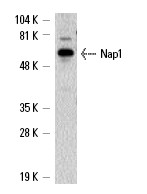
Western blot analysis of Nap1 expression in S. cerevisiae whole cell lysate.| Product Name | Nap1 Antibody (y-417) |
|---|---|
| Antibody Type | Primary Antibodies |
| Antigen Alias | epitope corresponding to amino acids 1-417 representing full length Nap1 of Saccharomyces cerevisiae origin |
| Modification Notes | Cell cycle progression is controlled at a point late in G1, designated Start. Passage through Start requires the activity of the cyclin-dependent protein kinase Cdc28 (1,2). Transition from G1 to S phase requires the association of Cdc28 with members of the the G1 cyclin family, including Cln1, Cln2 and Cln3 (also designated Daf1 or Whi1) (3). The G2 to M phase transition requires the M phase cyclins, Clb1 (also referred to as SCB1) and Clb2, as well as the G2 cyclins, Clb3 and Clb4 (4,5). CLB2 is bound by Nap1, a protein required for Clb2 to function in specific mitotic events (6). Nap1 is also required for Clb2 to induce the transition from polar to isotropic bud growth (7,8). |
| Clonality | Polyclonal |
|---|---|
| Isotype | IgG |
| Host Species | Rabbit |
| Tested Applications | WBIPELISA |
| recommended for detection of Nap1 of Saccharomyces cerevisiae origin by WB, IP and ELISA: |
|
| Species Reactivity | HumanMouseRat |
| Concentration | 1mg/ml |
| Purification | Affinity purified |
| Alternative Names | epitope corresponding to amino acids 1-417 representing full length Nap1 of Saccharomyces cerevisiae origin |
|---|---|
| Tissue Specificity | epitope corresponding to amino acids 1-417 representing full length Nap1 of Saccharomyces cerevisiae origin |
Application
Western blot analysis of Nap1 expression in S. cerevisiae whole cell lysate.| Application Notes | recommended for detection of Nap1 of Saccharomyces cerevisiae origin by WB, IP and ELISA: |
|---|
| Form | Liquid |
|---|---|
| Storage Instructions | For short-term storage, store at 4° C. For long-term storage, aliquot and store at -20ºC or below. Avoid multiple freeze-thaw cycles. |
| Storage Buffer | phosphate buffered saline , pH 7.4, 150mM NaCl, 0.02% sodium azide and 50% glycerol. |


