Application
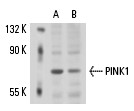
Western blot analysis of PINK1 expression in rat brain (A) and mouse brain (B) tissue extracts.| Product Name | PINK1 Antibody (H-300) |
|---|---|
| Antibody Type | Primary Antibodies |
| Modification Notes | A member of the serine/threonine protein kinase family, PTEN induced putative kinase 1 (PINK1) is a tumor suppressor. PINK1 is primarily located in mitochondria, and is ubiquitously expressed in testis, skeletal muscle, and heart tissue. It can also be detected at lower levels in pancreas, ovary, brain, placenta, kidney, liver, prostate and small intestine. During cellular stress PINK1 protects against mitochondrial dysfunction by inducing phosphorylation mitochondrial proteins. PINK1 mutations may give rise to different autophosphorylation activity. Mutations in the PINK1 gene (PARK6) are associated with early onset Parkinson’s disease, a recessive neurodegenerative disorder characterized by resting tremor, muscular rigidity, bradykinesia and postural instability. Parkinson’s disease generally involves the presence of intraneuronal accumulations of aggregated proteins (Lewy bodies) in brain neurons. |
| Clonality | Polyclonal |
|---|---|
| Isotype | IgG |
| Host Species | Rabbit |
| Tested Applications | WBIPIFELISA |
| recommended for detection of PINK1 of mouse, rat and human origin by WB, IP, IF and ELISA also reactive with additional species, including equine, canine, bovine and porcine | |
| Species Reactivity | HumanMouseRat |
| Concentration | 1mg/ml |
| Purification | Affinity purified |
| Alternative Names | epitope corresponding to amino acids 282-581 mapping at the C-terminus of PINK1 of human origin |
|---|---|
| Tissue Specificity | epitope corresponding to amino acids 282-581 mapping at the C-terminus of PINK1 of human origin |
| Entrez Gene | 65018 |
|---|
Application
Western blot analysis of PINK1 expression in rat brain (A) and mouse brain (B) tissue extracts.| Application Notes | recommended for detection of PINK1 of mouse, rat and human origin by WB, IP, IF and ELISA also reactive with additional species, including equine, canine, bovine and porcine |
|---|
| Form | Liquid |
|---|---|
| Storage Instructions | For short-term storage, store at 4° C. For long-term storage, aliquot and store at -20ºC or below. Avoid multiple freeze-thaw cycles. |
| Storage Buffer | phosphate buffered saline , pH 7.4, 150mM NaCl, 0.02% sodium azide and 50% glycerol. |


