Application
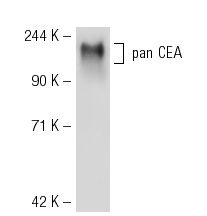
Western blot analysis of pan CEA expression in MCF7 whole cell lysate.Application
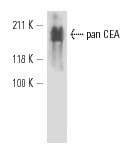
Western blot analysis of pan CEA expression in LS1034 whole cell lysate.| Product Name | pan CEA Antibody (H-300) |
|---|---|
| Antibody Type | Primary Antibodies |
| Antigen Alias | epitope corresponding to amino acids 35-334 mapping near the N-terminus of CEA (carcinoembryonic antigen) of human origin |
| Modification Notes | Carcinoembryonic antigen (CEA) is one of the most commonly used tumor markers in serum immunoassay determinations of carcinoma. Members of the CEACAM (carcinoembryonic antigen-related cell adhesion molecule) family contain a single N domain, with structural homology to the immunoglobulin variable domains, followed by a variable number of immunoglobulin constant-like A and/or B domains. CEACAMS, such as CEACAM1, CEACAM7, CD66C, CD66D and CD66E, have diverse roles within the cell, including roles in the differentiation and arrangement of tissue three-dimensional structure, angiogenesis, apoptosis, tumor suppression, metastasis, and the modulation of innate and adaptive immune responses. The human CEACAM proteins are encoded by genes which are located within a 1.2 Mb cluster on the long arm of chromosome 19. |
| Clonality | Polyclonal |
|---|---|
| Isotype | IgG |
| Host Species | Rabbit |
| Tested Applications | WBIPIFELISA |
| broadly reactive with CEA (CD66 isoforms) family members and CEA related molecules of human origin by WB, IP, IF and ELISA: |
|
| Species Reactivity | HumanMouseRat |
| Concentration | 1mg/ml |
| Purification | Affinity purified |
| Alternative Names | epitope corresponding to amino acids 35-334 mapping near the N-terminus of CEA (carcinoembryonic antigen) of human origin |
|---|---|
| Tissue Specificity | epitope corresponding to amino acids 35-334 mapping near the N-terminus of CEA (carcinoembryonic antigen) of human origin |
| Entrez Gene | 1048 |
|---|
Application
Western blot analysis of pan CEA expression in MCF7 whole cell lysate.
Application
Western blot analysis of pan CEA expression in LS1034 whole cell lysate.| Application Notes | broadly reactive with CEA (CD66 isoforms) family members and CEA related molecules of human origin by WB, IP, IF and ELISA: |
|---|
| Form | Liquid |
|---|---|
| Storage Instructions | For short-term storage, store at 4° C. For long-term storage, aliquot and store at -20ºC or below. Avoid multiple freeze-thaw cycles. |
| Storage Buffer | phosphate buffered saline , pH 7.4, 150mM NaCl, 0.02% sodium azide and 50% glycerol. |


