Application
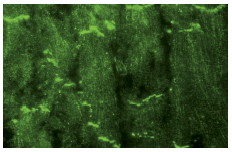
Immunofluorescence staining of normal mouse heart frozen section showing membrane staining.| Product Name | L-type Ca++ CP α1C Antibody (H-280) |
|---|---|
| Antibody Type | Primary Antibodies |
| Antigen Alias | epitope corresponding to amino acids 1721-2000 mapping within an internal region of L-type Ca++ CP α1C of human origin |
| Modification Notes | Voltage-dependent Ca++ channels mediate Ca++ entry into excitable cells in response to membrane depolarization, and they are involved in a variety of Ca++-dependent processes, including muscle contraction, hormone or neurotransmitter release and gene expression. Calcium channels are highly diverse, multimeric complexes composed of an ?-1 subunit, an intracellular ?-subunit, a disulfide linked ?-2/? subunit and a transmembrane ?-subunit. Ca++ currents are characterized on the basis of their biophysical and pharmacologic properties and include L-, N-, T-, P-, Q-, and R- types. L-type Ca++ currents initiate muscle contraction, endocrine secretion, and gene transcription, and can be regulated through second-messenger activated protein phosphorylation pathways. L-type calcium channels may form macromolecular signaling complexes with G protein-coupled receptors, thereby enhancing the selectivity of regulating specific targets. |
| Clonality | Polyclonal |
|---|---|
| Isotype | IgG |
| Host Species | Rabbit |
| Tested Applications | WBIPIFELISA |
| recommended for detection of L-type Ca++ CP α1C of mouse, rat and human origin by WB, IP, IF and ELISA: |
|
| Species Reactivity | HumanMouseRat |
| Concentration | 1mg/ml |
| Purification | Affinity purified |
| Alternative Names | epitope corresponding to amino acids 1721-2000 mapping within an internal region of L-type Ca++ CP &alpha 1C of human origin |
|---|---|
| Tissue Specificity | epitope corresponding to amino acids 1721-2000 mapping within an internal region of L-type Ca++ CP α1C of human origin |
| Entrez Gene | 775 |
|---|
Application
Immunofluorescence staining of normal mouse heart frozen section showing membrane staining.| Application Notes | recommended for detection of L-type Ca++ CP α1C of mouse, rat and human origin by WB, IP, IF and ELISA: |
|---|
| Form | Liquid |
|---|---|
| Storage Instructions | For short-term storage, store at 4° C. For long-term storage, aliquot and store at -20ºC or below. Avoid multiple freeze-thaw cycles. |
| Storage Buffer | phosphate buffered saline , pH 7.4, 150mM NaCl, 0.02% sodium azide and 50% glycerol. |


