Application
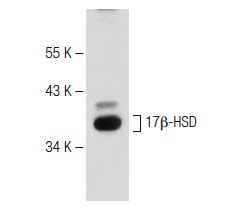
Western blot analysis of 17β-HSD expression in BT-20 whole cell lysate.| Product Name | 17β-HSD Antibody (M-174) |
|---|---|
| Antibody Type | Primary Antibodies |
| Antigen Alias | epitope corresponding to amino acids 171-344 mapping at the C-terminus of 17β-HSD of mouse origin |
| Modification Notes | 17b-hydroxysteroid dehydrogenase type 1 (17b-HSD) catalyzes the final step in the formation of estradiol and testosterone from estrone and androstenedione, respectively. Ovarian granulosa cells and breast tissue both express 17b-HSD. Other tissues that express 17b-HSD include testis, placenta, uterus, prostate and adipose tissue. 17b-HSD functions as a homodimer and prefers NADP(H) over NAD(H) for oxidation and reduction. The gene encoding human 17b-HSD maps to chromosome 17q12-q21. The importance of 17b-HSD to estradiol production suggests the specific inhibition of 17b-HSD may aid in breast cancer therapy. Breast cancer patients with an amplification of 17b-HSD expression statistically have a worse outcome than those without. 17b-HSD amplification in tamoxifen-treated patients correlates to decreased breast cancer survival. |
| Clonality | Polyclonal |
|---|---|
| Isotype | IgG |
| Host Species | Rabbit |
| Tested Applications | WBIPIFELISA |
| recommended for detection of 17β-HSD of mouse, rat and, to a lesser extent, human origin by WB, IP, IF and ELISA: |
|
| Species Reactivity | HumanMouseRat |
| Concentration | 1mg/ml |
| Purification | Affinity purified |
| Alternative Names | epitope corresponding to amino acids 171-344 mapping at the C-terminus of 17&beta -HSD of mouse origin |
|---|---|
| Tissue Specificity | epitope corresponding to amino acids 171-344 mapping at the C-terminus of 17β-HSD of mouse origin |
| Entrez Gene | 3292 |
|---|
Application
Western blot analysis of 17β-HSD expression in BT-20 whole cell lysate.| Application Notes | recommended for detection of 17β-HSD of mouse, rat and, to a lesser extent, human origin by WB, IP, IF and ELISA: |
|---|
| Form | Liquid |
|---|---|
| Storage Instructions | For short-term storage, store at 4° C. For long-term storage, aliquot and store at -20ºC or below. Avoid multiple freeze-thaw cycles. |
| Storage Buffer | phosphate buffered saline , pH 7.4, 150mM NaCl, 0.02% sodium azide and 50% glycerol. |


