Application
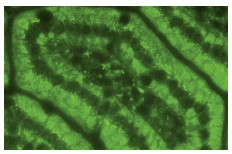
Immunofluorescence staining of normal mouse intestine frozen section showing cytoplasmic staining.Application
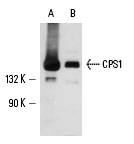
Western blot analysis of CPS1 expression in mouse liver tissue extract (A) and HeLa whole cell lysate (B).| Product Name | CPS1 Antibody (H-140) |
|---|---|
| Antibody Type | Primary Antibodies |
| Modification Notes | The multicomplex protein, carbamoyl-phosphate synthetase-aspartate carbamoyl transferase-dihydro-orotase (CAD), consists of three distinct proteins, carbamoyl phosphate synthetase 2 (CPS2), aspartate transcarbamylase, and dihydro-orotase, which catalyze the second and third steps of pyrimidine biosynthesis. CAD is allosterically regulated by the phosphorylation of CPS2 by cyclic AMP-dependent protein kinase, and this activation enables CPS2 to catalyze the rate-limiting step of pyrimidine synthesis. CAD is expressed in brain and skeletal muscle. A related protein, carbamoyl phosphate synthetase 1 (CPS1) is expressed in liver. CPS1 catalyzes the rate-limiting step in the urea cycle, and deficiency of CPS1 is an autosomal recessive disorder that causes hyperammonemia. |
| Clonality | Polyclonal |
|---|---|
| Isotype | IgG |
| Host Species | Rabbit |
| Tested Applications | WBIPIFELISA |
| recommended for detection of CPS1 of mouse, rat and human origin by WB, IP, IF and ELISA also reactive with additional species, including equine, canine, bovine and porcine | |
| Species Reactivity | HumanMouseRat |
| Concentration | 1mg/ml |
| Purification | Affinity purified |
| Alternative Names | epitope corresponding to amino acids 1361-1500 mapping at the C-terminus of CPS1 of human origin |
|---|---|
| Tissue Specificity | epitope corresponding to amino acids 1361-1500 mapping at the C-terminus of CPS1 of human origin |
| Entrez Gene | 1373 |
|---|
Application
Immunofluorescence staining of normal mouse intestine frozen section showing cytoplasmic staining.
Application
Western blot analysis of CPS1 expression in mouse liver tissue extract (A) and HeLa whole cell lysate (B).| Application Notes | recommended for detection of CPS1 of mouse, rat and human origin by WB, IP, IF and ELISA also reactive with additional species, including equine, canine, bovine and porcine |
|---|
| Form | Liquid |
|---|---|
| Storage Instructions | For short-term storage, store at 4° C. For long-term storage, aliquot and store at -20ºC or below. Avoid multiple freeze-thaw cycles. |
| Storage Buffer | phosphate buffered saline , pH 7.4, 150mM NaCl, 0.02% sodium azide and 50% glycerol. |


