Application
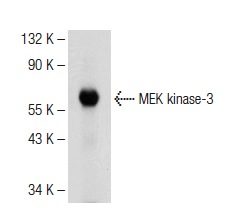
Western blot analysis of MEK kinase-3 expression in rat small intestine tissue extract.Application
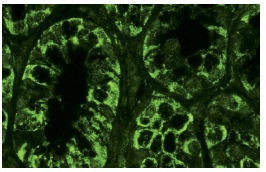
Immunofluorescence staining of normal mouse intestine frozen section showing cytoplasmic staining.| Product Name | MEK kinase-3 Antibody (H-70) |
|---|---|
| Antibody Type | Primary Antibodies |
| Modification Notes | Mitogen-activated protein (MAP) kinase cascades are activated by various extracellular stimuli including growth factors. The MEK kinases (also designated MAP kinase kinase kinases, MKKKs, MAP3Ks or MEKKs) phosphorylate and thereby activate the MEKs (also called MAP kinase kinases or MKKs), including ERK, JNK and p38. These activated MEKs in turn phosphorylate and activate the MAP kinases. The MEK kinases include Raf-1, Raf-B, Mos, MEK kinase-1, MEK kinase-2, MEK kinase-3, MEK kinase-4, ASK 1 (MEK kinase-5) and MAP3K6 (MEK kinase-6). MEK kinase-1 has been shown to phosphorylate MEK-1 via a Raf-independent pathway. Evidence suggests that MEK-3 is preferentially activated by MEK kinase-3 and that MEK-4 is activated by both MEK kinase-2 and MEK kinase-3. MEK kinase-4 has been shown to specifically activate the JNK pathway. ASK1 activates both MEK-4 and MEK-3/MEK-6 pathways. |
| Clonality | Polyclonal |
|---|---|
| Isotype | IgG |
| Host Species | Rabbit |
| Tested Applications | WBIPIFELISA |
| recommended for detection of MEK kinase-3 of mouse, rat and human origin by WB, IP, IF and ELISA also reactive with additional species, including equine, canine, bovine, porcine and avian | |
| Species Reactivity | HumanMouseRat |
| Concentration | 1mg/ml |
| Purification | Affinity purified |
| Alternative Names | epitope corresponding to amino acids 291-360 mapping within an internal region of MEK kinase-3 of human origin |
|---|---|
| Tissue Specificity | epitope corresponding to amino acids 291-360 mapping within an internal region of MEK kinase-3 of human origin |
| Entrez Gene | 4215 |
|---|
Application
Western blot analysis of MEK kinase-3 expression in rat small intestine tissue extract.
Application
Immunofluorescence staining of normal mouse intestine frozen section showing cytoplasmic staining.| Application Notes | recommended for detection of MEK kinase-3 of mouse, rat and human origin by WB, IP, IF and ELISA also reactive with additional species, including equine, canine, bovine, porcine and avian |
|---|
| Form | Liquid |
|---|---|
| Storage Instructions | For short-term storage, store at 4° C. For long-term storage, aliquot and store at -20ºC or below. Avoid multiple freeze-thaw cycles. |
| Storage Buffer | phosphate buffered saline , pH 7.4, 150mM NaCl, 0.02% sodium azide and 50% glycerol. |


