Application
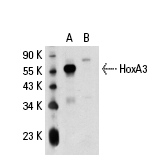
Western blot analysis of HoxA3 expression in human HoxA3 transfected: (A) and non-transfected: (B) 293 whole cell lysates.| Product Name | HoxA3 Antibody (H-165) |
|---|---|
| Antibody Type | Primary Antibodies |
| Modification Notes | The Hox proteins play a role in development and cellular differentiation by regulating downstream target genes. Specifically, the Hox proteins direct DNA-protein and protein-protein interactions that assist in determining the morphologic features associated with the anterior-posterior body axis. The mammalian HOX gene complex consists of 39 genes that are located on four linkage groups, which are dispersed over four chromosomes. HOX genes that occupy the same relative position along the 5’ to 3’ coordinate (trans-paralogous genes) are more similar in sequence and expression pattern than adjacent HOX genes on the same chromosome. HoxA3, in conjunction with Pax1, mediates the development of the thymus, parathyroid gland, and carotid body. Its expression in the third pharyngeal arch and pouch is required for development of the third arch artery, and homozygous null HoxA3 mutants lack the carotid body. HoxA3 also regulates hindbrain development by controlling the axon projection pattern of motor neurons and sensory neurons of the proximal and distal ganglia. |
| Clonality | Polyclonal |
|---|---|
| Isotype | IgG |
| Host Species | Rabbit |
| Tested Applications | WBIPIFELISAGSChIP |
| recommended for detection of HoxA3 of mouse, rat and human origin by WB, IP, IF and ELISA also reactive with additional species, including canine, bovine and porcine | |
| Species Reactivity | HumanMouseRat |
| Concentration | 1mg/ml |
| Purification | Affinity purified |
| Alternative Names | epitope corresponding to amino acids 251-415 mapping near the C-terminus of HoxA3 of human origin |
|---|---|
| Tissue Specificity | epitope corresponding to amino acids 251-415 mapping near the C-terminus of HoxA3 of human origin |
| Entrez Gene | 3200 |
|---|
Application
Western blot analysis of HoxA3 expression in human HoxA3 transfected: (A) and non-transfected: (B) 293 whole cell lysates.| Application Notes | recommended for detection of HoxA3 of mouse, rat and human origin by WB, IP, IF and ELISA also reactive with additional species, including canine, bovine and porcine |
|---|
| Form | Liquid |
|---|---|
| Storage Instructions | For short-term storage, store at 4° C. For long-term storage, aliquot and store at -20ºC or below. Avoid multiple freeze-thaw cycles. |
| Storage Buffer | phosphate buffered saline , pH 7.4, 150mM NaCl, 0.02% sodium azide and 50% glycerol. |


