Application
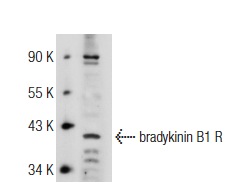
Western blot analysis of bradykinin B1 R expression in KNRK whole cell lysate.| Product Name | bradykinin B1 R Antibody (H-90) |
|---|---|
| Antibody Type | Primary Antibodies |
| Modification Notes | Kinins are important biologically active peptides that mediate cardiovascular homeostasis, inflammation and nociception. Bradykinin, the major effector peptide of the kallikrein-kinin system, is regulated by angiotensin-converting enzyme (ACE), which degrades the peptide. Bradykinin normally exerts its effects through the activation of two seven transmembrane G-protein coupled receptors, named B1 and B2. The B2 receptor is constitutively expressed and preferentially binds full length bradykinin. Deletion of the B2 receptor leads to salt-sensitive hypertension and altered nociception in mice. The B1 receptor binds to derivatives of bradykinin and kallidin, which are produced by carboxypeptidase action to generate the products des-Arg9-bradykinin and des-Arg10-kallidin, respectively. The expression of the B1 receptor is inducible by inflammatory mediators, such as bacterial lipopolysaccharide (LPS) and cytokines. The B1 and B2 receptors represent potential therapeutic targets for treatment of inflammatory disorders and cardiovascular diseases. |
| Clonality | Polyclonal |
|---|---|
| Isotype | IgG |
| Host Species | Rabbit |
| Tested Applications | WBIPIFELISA |
| recommended for detection of bradykinin B1 receptor of mouse, rat and human origin by WB, IP, IF and ELISA | |
| Species Reactivity | HumanMouseRat |
| Concentration | 1mg/ml |
| Purification | Affinity purified |
| Alternative Names | epitope corresponding to amino acids 216-305 of bradykinin B1 R of human origin |
|---|---|
| Tissue Specificity | epitope corresponding to amino acids 216-305 of bradykinin B1 R of human origin |
| Entrez Gene | 623 |
|---|
Application
Western blot analysis of bradykinin B1 R expression in KNRK whole cell lysate.| Application Notes | recommended for detection of bradykinin B1 receptor of mouse, rat and human origin by WB, IP, IF and ELISA |
|---|
| Form | Liquid |
|---|---|
| Storage Instructions | For short-term storage, store at 4° C. For long-term storage, aliquot and store at -20ºC or below. Avoid multiple freeze-thaw cycles. |
| Storage Buffer | phosphate buffered saline , pH 7.4, 150mM NaCl, 0.02% sodium azide and 50% glycerol. |


