Application
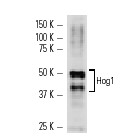
Western blot analysis of yeast recombinant Hog1 fusion protein.| Product Name | Hog1 Antibody (y-215) |
|---|---|
| Antibody Type | Primary Antibodies |
| Modification Notes | Yeast cells regulate their internal osmolarity in response to the environment via a MAP kinase cascade. MAP kinase cascades, which transmit extracellular signals to the cytoplasm or nucleuscomprise, comprise an essential branch of signal transduction. The core of these cascades consist of a MAP kinase (mitogen activated protein kinase, also called ERK, for extracellular-regulated protein kinase) as well as one or more up-stream regulatory kinases (MAPKKs or MEKs, for MAP/ERK kinase). High external osmolarity leads to the activation of the MAPKK Pbs2, which activates the MAP kinase Hog1. Hog1 (also called Ssk3) is thought to activate a transcription factor that upregulates the production of osmo-regulatory proteins. |
| Clonality | Polyclonal |
|---|---|
| Isotype | IgG |
| Host Species | Rabbit |
| Tested Applications | WBIPELISA |
| recommended for detection of HOG1 of Saccharomyces cerevisiae origin by WB, IP and ELISA | |
| Species Reactivity | HumanMouseRat |
| Concentration | 1mg/ml |
| Purification | Affinity purified |
| Alternative Names | epitope corresponding to amino acids 221-435 mapping at the carboxy terminus of HOG1 of Saccharomyces cerevisiae origin |
|---|---|
| Tissue Specificity | epitope corresponding to amino acids 221-435 mapping at the carboxy terminus of HOG1 of Saccharomyces cerevisiae origin |
Application
Western blot analysis of yeast recombinant Hog1 fusion protein.| Application Notes | recommended for detection of HOG1 of Saccharomyces cerevisiae origin by WB, IP and ELISA |
|---|
| Form | Liquid |
|---|---|
| Storage Instructions | For short-term storage, store at 4° C. For long-term storage, aliquot and store at -20ºC or below. Avoid multiple freeze-thaw cycles. |
| Storage Buffer | phosphate buffered saline , pH 7.4, 150mM NaCl, 0.02% sodium azide and 50% glycerol. |


