Application
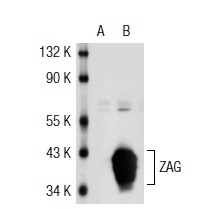
Western blot analysis of ZAG expression in non-transfected: (A) and human ZAG transfected: (B) 293T whole cell lysates.| Product Name | ZAG Antibody (H-123) |
|---|---|
| Antibody Type | Primary Antibodies |
| Modification Notes | ZAG (Zn-a2-glycoprotein, also designated Zn-a2-gp) is a soluble, secreted protein found in serum and other body fluids (such as cerebrospinal fluid, blood plasma, urine and sweat). ZAG has a tendency to precipitate with zinc salts, has electrophoretic mobility in the region of the two globulins, and has 18% carbohydrate content. A member of the immunoglobulin superfamily, ZAG has a high degree of sequence similarity to class-I major histocompatibility complex (MHC) antigens. The ZAG structure includes a large groove analogous to class I MHC peptide binding grooves. The crystal structure of ZAG resembles a class I MHC heavy chain but does not bind the class I light chain b-2-Microglobulin, unlike other MHC related proteins. ZAG stimulates lipid degradation in adipocytes and its overexpression causes the extensive fat losses associated with some advanced cancers. |
| Clonality | Polyclonal |
|---|---|
| Isotype | IgG |
| Host Species | Rabbit |
| Tested Applications | WBIPIFELISA |
| recommended for detection of ZAG human and, to a lesser extent, mouse and rat origin by WB, IP, IF and ELISA | |
| Species Reactivity | HumanMouseRat |
| Concentration | 1mg/ml |
| Purification | Affinity purified |
| Alternative Names | epitope corresponding to amino acids 13-135 mapping near the N-terminus of Zn-&alpha 2-glycoprotein (ZAG) of human origin |
|---|---|
| Tissue Specificity | epitope corresponding to amino acids 13-135 mapping near the N-terminus of Zn-α2-glycoprotein (ZAG) of human origin |
| Entrez Gene | 563 |
|---|
Application
Western blot analysis of ZAG expression in non-transfected: (A) and human ZAG transfected: (B) 293T whole cell lysates.| Application Notes | recommended for detection of ZAG human and, to a lesser extent, mouse and rat origin by WB, IP, IF and ELISA |
|---|
| Form | Liquid |
|---|---|
| Storage Instructions | For short-term storage, store at 4° C. For long-term storage, aliquot and store at -20ºC or below. Avoid multiple freeze-thaw cycles. |
| Storage Buffer | phosphate buffered saline , pH 7.4, 150mM NaCl, 0.02% sodium azide and 50% glycerol. |


