Application
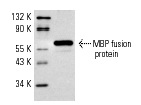
Western blot analysis of MBP-tagged fusion protein.| Product Name | MBP-probe Antibody (N-17) |
|---|---|
| Antibody Type | Primary Antibodies |
| Modification Notes | Plasmid vectors for the expression of coding regions of eukaryotic genes in bacterial, insect and mammalian hosts are in common usage; such expression vectors frequently encode hybrid fusion proteins consisting in part of prokaryotic and in part, eukaryotic specified proteins (1-4). One such system utilizes maltose binding protein (MBP), the 370 amino acid product of the E. coli mal E gene (2). Plasmid vectors have been constructed utilizing the MBP domain that allow the synthesis of high levels of MBP-fusion proteins that can be purified in a one step procedure by affinity chromatography cross linked amylose resin (5,6). Once bound to amylose, the MBP protein can then be separated from the target protein by cleavage by coagulation factor Xa at a specific four residue site (5,6). Alternatively, the intact fusion protein can be specifically eluted from the resin by the addition of excess free maltose (5,6). Subsequent to elution, MBP fusion protein can be visualized either by Western blot analysis or immunoprecipitation using antibodies specific for the MBP-tag. Expression systems utilizing the MBP fusion tag include pCG-806fx and pMal vectors. |
| Clonality | Polyclonal |
|---|---|
| Isotype | IgG |
| Host Species | Rabbit |
| Tested Applications | WBELISA |
| recommended for detection of pMal expression vector-encoded MBP fusion proteins by WB and ELISA | |
| Species Reactivity | HumanMouseRat |
| Concentration | 1mg/ml |
| Purification | Affinity purified |
| Alternative Names | epitope mapping within the N-terminus of MBP-probe |
|---|---|
| Tissue Specificity | epitope mapping within the N-terminus of MBP-probe |
Application
Western blot analysis of MBP-tagged fusion protein.| Application Notes | recommended for detection of pMal expression vector-encoded MBP fusion proteins by WB and ELISA |
|---|
| Form | Liquid |
|---|---|
| Storage Instructions | For short-term storage, store at 4° C. For long-term storage, aliquot and store at -20ºC or below. Avoid multiple freeze-thaw cycles. |
| Storage Buffer | phosphate buffered saline , pH 7.4, 150mM NaCl, 0.02% sodium azide and 50% glycerol. |


